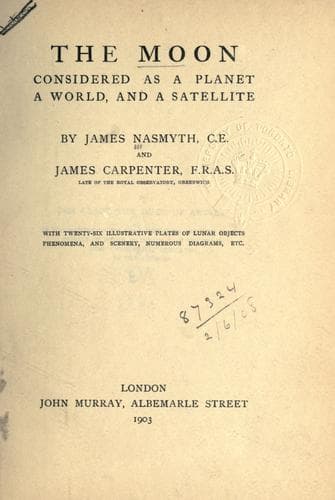
The Moon: considered as a planet, a world, and a satellite.Nasmyth, James
Science
The Moon: considered as a planet, a world, and a satellite.
Nasmyth, James
Moon
The lunar method for longitude amounts practically to this. The stars
are fixed; the sun, moon, and planets move amongst them; the sun and
planets with very slow rates of apparent motion, the moon with a very
rapid one. If, then, it be predicted that at a certain instant of
Greenwich time the moon will be a certain distance from a fixed star,
and if the mariner at sea observes _when_ the moon has that exact
distance, he will know the Greenwich time at the instant of his
observation.[20] The moon thus becomes to him as the hand of a
timepiece, whereof the stars are the hour and minute marks, the whole
being, as it were, set to Greenwich time. Then if he knows (which he
does by other observations easily obtained) the local time at his ship,
he can take the difference between the Greenwich time and his time,
which difference is in fact his longitude from Greenwich. The requisite
predictions of the distance of the moon from several fixed stars near
her are given to the utmost exactness for every three hours of every day
and night (when the moon can possibly be seen) in the navigator’s _vade
mecum_, the “Nautical Almanac,” and from these given distances the
navigator can, by a simple process of differencing, obtain the distance,
and hence the Greenwich time, for any intermediate instant at which he
may chance to make his observation. Whenever he can see the moon he can
obtain Greenwich time. Of course the whole value of this method depends
upon the exactitude of the predicted distances corresponding to the
given Greenwich times. These distances are obtained by tables of the
moon’s motions, which must be found from observations. The motions in
question are of an intricacy almost past comprehension, on account of
the disturbing forces to which the moon is subjected by the sun and
planets. The powers of the profoundest mathematicians, from Newton
downwards, have been severely exercised in efforts to group them into a
theory, and represent them by tables capable of furnishing the requisite
exact predictions of lunar positions for nautical purposes. Accurate
observations of the moon’s place night after night have, from the dawn
of this lunar method for longitude, been in urgent request by
mathematicians for the purposes specified, and it was solely to procure
these observations that the Observatory at Greenwich was established,
and mainly for their continued prosecution (and for the stellar
observations necessary for their utilization) that it is sustained. For
two centuries the moon has been unremittingly observed at Greenwich, and
the tables at present used for making the “Nautical Almanac” (those
formed by Prof. Hansen) depend upon the observations there obtained. The
work still goes on, for even now the degree of exactitude is not what is
desired, and astronomers are looking forward with some interest to new
lunar tables which were left complete by the late M. Delaunay, formerly
the head of astronomy in France, based upon a theory which he evolved.
Public-domain text, read in full here on John Shaqi.
Reviews
Reviews
No reviews yet
Be the first to share your thoughts on this work.
Elsewhere in the archive
Join the Discussion
Join the discussion
Sign in to leave a comment or review.
Sign InorCreate an account