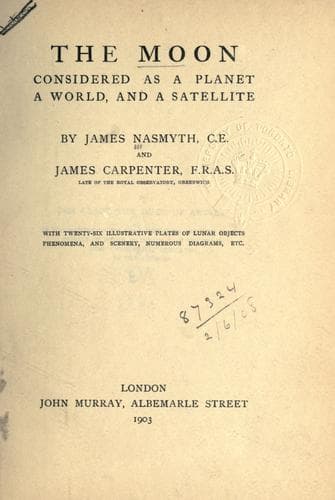
The Moon: considered as a planet, a world, and a satellite.Nasmyth, James
Science
The Moon: considered as a planet, a world, and a satellite.
Nasmyth, James
Moon
This use of the moon is the grandest of all in respect of the results to
which it has led.
Then, too, regarding the moon as a timekeeper, we must not forget the
service that it renders in furnishing a division of time intermediate
between the day—which is measured by the earth’s rotation—and the year,
which is defined by the earth’s orbital revolution. Notwithstanding the
survival of lunar reckoning in our religious services, we, in our time
and country, scarcely need a moon to mark our months; but we must not
forget that with many ancient people the moon was, and with some is
still, the chief timekeeper, the calendars of such people being lunar
ones, and all their events being reckoned and dated by “moons.” To us,
however, the moon is of great service in this department by enabling us
to fix dates to many historical events, the times of occurrence of which
are uncertain, by reason of defective records or by dependence upon such
uncertain data as “lives of emperors,” years of this or that king’s
reign, or generations of one or another family. The moon now and then
clears up a mystery, or decides a disputed point in chronology, by
furnishing the accurate date of an ancient eclipse, which was a
phenomenon that always inspired awe and secured for itself careful
record. The chronologer is continually applying to the astronomer for
the date and place of visibility of some total eclipse, of which he has
found an imperfect record, veritable as to the fact, but dated only by
reference to some year of a so-and-so’s reign, or by some battle or
other historical occurrence. The eclipses that occurred near the time
are then examined, and when one is found that tallies with recorded
conditions in other respects (such as the time of day and the place of
observation), its indisputable date becomes a starting-point from which
the chronologer works backwards and forwards in safety. There is one
famous eclipse—that predicted by Thales six centuries before Christ,
which put an end to the battle between the Medes and Lydians by the
terror its darkness created in both armies—which is most intimately
associated with ancient chronology, and has been used to rectify a
proximate date (the first year of Cyrus of Babylon) which forms the
foundation of all Scripture chronology. Sacred and profane history alike
are continually receiving assistance from the accurate dates which the
moon, by having caused eclipses of the sun, enables the astronomer to
fix beyond cavil or doubt.
Public-domain text, read in full here on John Shaqi.
Reviews
Reviews
No reviews yet
Be the first to share your thoughts on this work.
Elsewhere in the archive
Join the Discussion
Join the discussion
Sign in to leave a comment or review.
Sign InorCreate an account