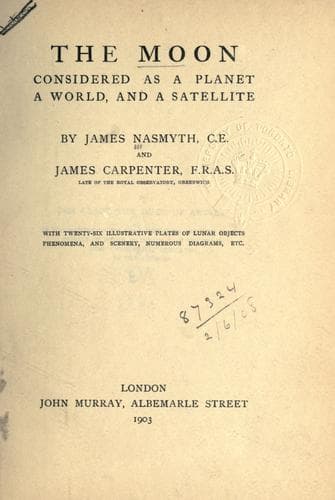
The Moon: considered as a planet, a world, and a satellite.Nasmyth, James
Science
The Moon: considered as a planet, a world, and a satellite.
Nasmyth, James
Moon
Reflections upon the uses of the moon not unnaturally lead our thoughts
to some matters that may be regarded as abuses. These mainly take the
form of superstitions, erroneous beliefs in the moon’s influence over
terrestrial conditions, and occasionally of erroneous ideas upon the
moon’s functions as a luminary. The first-mentioned are almost beneath
notice, for they include such mythical suspicions as that the moon
influences human sanity and other affections of mind and body; that the
moon’s rays have a decomposing effect upon organic matter; that they
produce blindness by shining upon a sleeper’s eyes; that the moon
determines the hours of human death, which is supposed to occur with the
change of the tide, etc. All such, having no foundation on fact, are put
beyond our consideration. The third matter we have mentioned may also be
dismissed in a very few words. The erroneous ideas upon the moon’s
functions as a luminary, to which we allude, are those which are
manifested by poets and painters, and even historians, who do not
hesitate to bring the moon upon a scene in any form and at any time they
please without reference to actual lunar circumstances. It is no
uncommon thing to see, in a picture representing an evening scene, a
moon introduced which can only be seen in the morning—a waning moon
instead of a waxing one; and astronomical critics have, indeed, caught
artists so far tripping as to put a moon in a picture representing some
event that occurred upon a date when the moon was new, and therefore
invisible. Writers take the same liberties very frequently. A newspaper
correspondent, during the Franco-Prussian war, described the full moon
as shining upon a scene of desolation on a particular night, when really
there was no moon to be seen. One of the most flagrant cases of this
kind, however, occurs in Wolfe’s ballad on “The death of Sir John
Moore,” where it is written that the hero was buried “By the struggling
moonbeam’s misty light.” But the interment actually took place at a time
when the moon was out of sight. We mention these abuses of the moon in
the hope of promoting a better observance of the moon’s luminary office.
They who wish to bring the moon upon a scene, not knowing _ipso facto_
that it was there, should first take the advice of Nick Bottom in the
“Midsummer Night’s Dream,” and make sure of their object by consulting
an almanac.
Public-domain text, read in full here on John Shaqi.
Reviews
Reviews
No reviews yet
Be the first to share your thoughts on this work.
Elsewhere in the archive
Join the Discussion
Join the discussion
Sign in to leave a comment or review.
Sign InorCreate an account