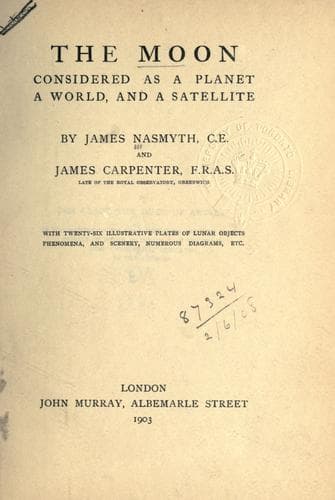
The Moon: considered as a planet, a world, and a satellite.Nasmyth, James
Science
The Moon: considered as a planet, a world, and a satellite.
Nasmyth, James
Moon
The second of the specified abuses to which the moon is subject refers
to its supposed influence on the weather; and in the extent to which it
goes this is one of the most deeply rooted of popular errors. That there
is an infinitesimal influence exerted by the moon on our atmosphere will
be seen from the evidence we have to offer, but it is of a character and
extent vastly different from what is commonly believed. The popular
error is shown in its most absurd form when the mere _aspect_ of the
moon, the mere transition from one phase of illumination to another, is
asserted to be productive of a change of weather; as if the gradual
passage from first quarter to second quarter, or from that to third,
could of itself upset an existing condition of the atmosphere; or as if
the conjunction of the moon with the sun could invert the order of the
winds, generate clouds, and pour down rains. A moment’s reasoning ought
to show that the supposed cause and the observed effect have no
necessary connection. In our climate the weather may be said to change
at least every three days, and the moon changes—to retain the popular
term—every seven days; so that the probability of a coincidence of these
changes is very great indeed: when it occurs, the moon is sure to be
credited with causing it. But a theory of this kind is of no use unless
it can be shown to apply in every case; and, moreover, the change must
always be in the same direction: to suppose that the moon can turn a
fine day to a wet one, and a wet day to a fine morrow indiscriminately,
is to make our satellite blow hot and cold with the same mouth, and so
to reduce the supposition to an absurdity. If any marked connection
existed between the state of the air and the aspect of the moon, it must
inevitably have forced itself unsought upon the attention of
meteorologists. In the weekly return of Births, Deaths, and Marriages,
issued by the Registrar-General, a table is given, showing all the
meteorological elements at Greenwich for every day of the year, and a
column is set apart for noting the changes and positions of the moon.
These reports extend backwards nearly a quarter of a century. Here,
then, is a repertory of data that ought to reveal at a glance any such
connection, and would certainly have done so had it existed. But no
constant relation between the moon columns and those containing the
instrument readings has ever been traced. Our meteorological
observatories furnish continuous and unbroken records of atmospheric
variations, extending over long series of years: these afford still more
abundant means for testing the validity of the lunar hypothesis. The
collation has frequently been made for special points in the inquiry,
and certainly _some_ connection has been found to obtain between certain
positions of the moon in her orbit and certain instrumental averages;
but so small are the effects traceable to lunar influence, that they are
Public-domain text, read in full here on John Shaqi.
Reviews
Reviews
No reviews yet
Be the first to share your thoughts on this work.
Elsewhere in the archive
Join the Discussion
Join the discussion
Sign in to leave a comment or review.
Sign InorCreate an account