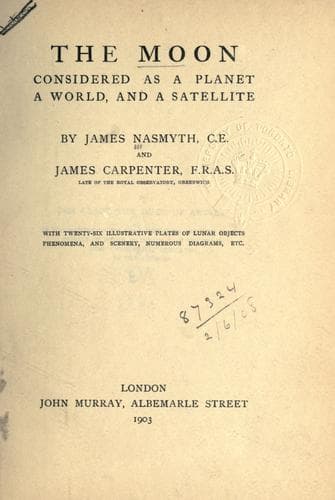
The Moon: considered as a planet, a world, and a satellite.Nasmyth, James
Science
The Moon: considered as a planet, a world, and a satellite.
Nasmyth, James
Moon
These descriptive matters disposed of, we proceeded to discuss the
various classes of surface features with a view to explaining the
precise actions which appear to us to have led to their formation.
Naturally the craters first demanded our attention. We pointed out the
reasons for regarding the great majority of the circular formations of
the moon as craters, as truly volcanic as those of which we have
examples, modified by obvious causes, upon the earth; and, tracing the
causative phenomena of terrestrial volcanoes, we showed how the
explanations which have been offered to account for them scarcely apply
to those of the moon: and thus, driven to other hypotheses, we
endeavoured to demonstrate the probability of the lunar craters having
been produced by eruptive force, generated by that pre-solidifying
expansion of successive portions of the moon’s molten interior, which we
enunciated in our third chapter. The precise course of phenomena which
resulted in the production of a crater of the normal lunar type, with or
without the significant central cone, were then illustrated by a series
of step-by-step diagrams with accompanying descriptive paragraphs. And
after treating of craters of the normal type we pointed out and
explained some variations thereupon that are here and there to be met
with, and likewise those curious complications of arrangement which
exhibit craters superimposed one upon another and intermingled in
strange confusion.
From craters manifestly volcanic we passed to the consideration of those
circular formations which, from their vastness of size, scarcely admit
of satisfactory explanation by a volcanic hypothesis. We summarized
several proffered theories of their origin, and pointed out what we
considered might be a possible key to the solution of the selenological
enigma which they constitute, without, however, expressing ourselves
entirely satisfied with the validity of our suggestion. The less
mysterious features presented by peaks and mountain ranges were then
discussed to the extent that we considered requisite, viewing their
comparatively simple character and the secondary position they occupy in
point of numerical importance upon the moon. At greater length we dealt
with the cracks and chasms and the allied phenomena of radiating
streaks, pointing out with regard to these latter the strikingly
beautiful correspondence in effect (and therefore presumably in cause)
between them and crack-systems of a glass globe “starred” by an
expanding internal medium.
Public-domain text, read in full here on John Shaqi.
Reviews
Reviews
No reviews yet
Be the first to share your thoughts on this work.
Elsewhere in the archive
Join the Discussion
Join the discussion
Sign in to leave a comment or review.
Sign InorCreate an account