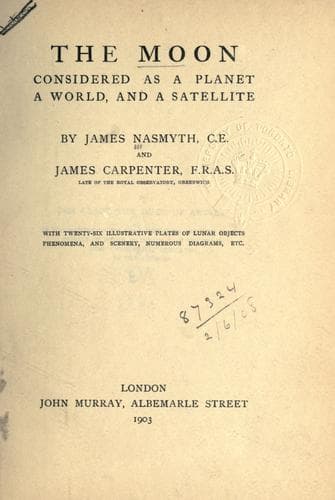
The Moon: considered as a planet, a world, and a satellite.Nasmyth, James
Science
The Moon: considered as a planet, a world, and a satellite.
Nasmyth, James
Moon
The incandescent sphere having attained its maximum degree of heat by
the total conversion thereinto of the gravitating force it embodied, we
explained how there must have ensued a dispersion of that heat by
radiation into surrounding space, resulting in the cooling and
consequent solidification of the outermost stratum of the lunar sphere,
and subsequently in the continuation of the cooling process downwards or
inwards to the centre. And here we essayed to prove that in this second
stage of the cooling process, when the crust was solid and the subjacent
portion of the molten sphere was about to solidify, there would come
into operation a principle which appears to govern the behaviour of
certain fusible substances, and which may be concisely termed the
principle of pre-solidifying expansion. We adduced several examples of
the manifestation of this principle, soliciting for it the careful
consideration of physicists and geologists, and looking to it as
furnishing the key to the mystery of volcanic action upon the moon,
since, without needing recourse to aqueous or gaseous sources of
eruptive power, it afforded a rationale of the ejection of the fluid and
semifluid matter of the moon through the solidified crust thereof, and
also of the dislocations of that crust, unattended by actual ejection of
subsurface matter, of which our satellite presents a variety of
examples, and which the earth also appears to have experienced at some
period of its formative history.
Arrived at this stage of our subject we thought it needful to introduce
some pages of data and descriptive detail. Accordingly in one chapter we
discussed the form, magnitude, weight, and density of the moon, and the
force of gravity at its surface: and the more soundly to fix these data
in the mind, we devoted a few lines to explanation of the methods
whereby each has been ascertained. We then examined the question (so
important to our subject) of the existence or non-existence of a lunar
atmosphere, giving the evidence, which may be regarded as conclusive, in
proof of the absence of both air and water from the moon, and,
therefore, refuting the claim of these elements to be considered as
sources or influants of the moon’s volcanic manifestations. A general
_coup-d’œil_ of the lunar hemisphere facing the earth next engaged our
attention, and we considered the aspect of the disc as it is viewed by
the naked eye and with telescopes of various powers. From this general
survey we passed to the topography of the moon, tracing briefly the
admirable labours of those who have advanced this subject, and, by aid
of picture and skeleton maps and a table of position co-ordinates,
placing it within the reader’s power to become more than sufficiently
acquainted for the purposes of this work with the names and positions of
detail objects and features of interest. Special descriptions of
interesting and typical spots and regions were given in some few cases
where such appeared to be called for.
Public-domain text, read in full here on John Shaqi.
Reviews
Reviews
No reviews yet
Be the first to share your thoughts on this work.
Elsewhere in the archive
Join the Discussion
Join the discussion
Sign in to leave a comment or review.
Sign InorCreate an account