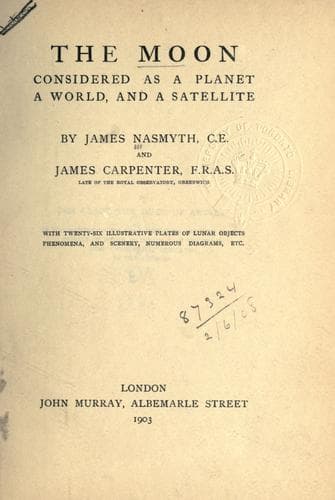
The Moon: considered as a planet, a world, and a satellite.Nasmyth, James
Science
The Moon: considered as a planet, a world, and a satellite.
Nasmyth, James
Moon
It is, however, sufficient for all purposes with which we are concerned
to regard the moon as a sphere, and the next point to be considered is
its size. To determine this, two data are necessary—its apparent or
angular diameter, and its distance from the earth. The first of these is
obtained by measuring the angle comprised between two lines directed
from the eye to two opposite “limbs” or edges of the moon. If, for
instance, we were to take a pair of compasses and, placing the joint at
the eye, open out the legs till the two points appear to touch two
opposite edges of the moon, the two legs would be inclined at an angle
which would represent the diameter of the moon, and this angle we could
measure by applying a divided arc or protractor to the compasses. In
practice this measurement is made by means of telescopes attached to
accurately divided circles; the difference between the readings of the
circle when the telescope is directed to opposite limbs of the moon
giving its angular diameter at the time of the observation. But from the
fact that the orbit of the moon is an ellipse, it is evident that she is
at some times much nearer to us than at others, and, as a consequence,
her apparent magnitude is variable: there is also a slight variation
depending upon the altitude of the moon at the time of the measure; the
mean diameter, however, or the diameter at mean distance from the centre
of the earth has, from long course of observation, been found to be 31′
9″.
To convert this apparent angular diameter into real linear measurement,
it is necessary to know either the distance of the moon from the earth,
or in astronomical language as leading to a knowledge of that distance,
what is the amount of the moon’s parallax. Parallax, generally, is an
apparent change of position of an object arising from change of the
point of view. The parallax of a heavenly body is the angle which the
earth would subtend if it were seen from that body. Supposing an
observer on the moon could measure the earth’s angular diameter, just as
we measure that of the moon, his measurement would represent what is
called the parallax of the moon. But we cannot go to the moon to make
such a measurement; nevertheless there is a simple method, explained in
most treatises on astronomy, which consists in observing the moon from
stations on the earth widely separated, and by which we can obtain a
precisely similar result. Without detailing the process, it is
sufficient for us to know that the angle which would be subtended by the
earth if seen from the moon, or the moon’s parallax, is according to the
latest determination, equal to 1° 54′ 5″. This value, however, varies
considerably with the variations of distance due to the elliptic orbit
of the moon: the number we have given represents the mean parallax, or
the parallax at mean distance.
Public-domain text, read in full here on John Shaqi.
Reviews
Reviews
No reviews yet
Be the first to share your thoughts on this work.
Join the Discussion
Join the discussion
Sign in to leave a comment or review.
Sign InorCreate an account