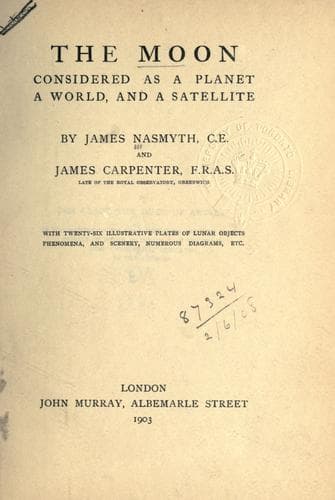
The Moon: considered as a planet, a world, and a satellite.Nasmyth, James
Science
The Moon: considered as a planet, a world, and a satellite.
Nasmyth, James
Moon
CHAPTER VI.
THE GENERAL ASPECT OF THE LUNAR SURFACE. 51
Pre-Telescopic Ideas—Human Countenance—Other supposed
Resemblances—Portrait of Full Moon—Permanence of
Features—Rotation of Moon—Solar Period and Solar Day on
Moon—Libration—Diurnal—In Latitude—In Longitude—Visible
and Invisible Hemispheres—Telescopic Scrutiny—Galileo’s
Views—Features Visible with Low Power—Low Powers on small
and large Telescopes—Salient
Features—Craters—Plains—Bright Streaks—Mountains—Higher
Telescopic Powers—Detail Scrutiny of Features
therewith—Discussion of High Powers—Education of
Eye—Highest practicable Power—Size of smallest Visible
Objects
CHAPTER VII.
TOPOGRAPHY OF THE MOON. 65
Reasons for Mapping the Moon—Early Maps—Labours of
Langreen—Hevelius—Riccioli—Cassini—Schroeter—Modern
Maps—Lohrman’s—Beer and Maedler’s—Excellence of the
last—Measurement of Mountain Heights—Need of a Picture
Map—Formation of our own—Skeleton Map—Table of conspicuous
Objects—Descriptions of special
Objects—Copernicus—Gassendi—Eudoxus and
Aristotle—Triesnecker—Theophilus, Cyrillus, and
Catharina—Thebit—Plato—Valley of the
Alps—Pico—Tycho—Wargentin—Aristarchus and
Herodotus—Walter—Archimedes and the Apennines
CHAPTER VIII.
ON LUNAR CRATERS. 89
Use of term Crater for Terrestrial and Lunar Formations—Truly
Volcanic Nature of Lunar Craters—Terrestrial and Lunar
Volcanic Areas compared—Similarity—Difference only in
Magnitude—Central Cone—Found in great and small Lunar
Craters—Formative Process of Terrestrial Volcanoes—Example
from Vesuvius—Vast Size of Lunar Craters—Reasons
assigned—Origin of Moon’s Volcanic Force—Aqueous Vapour
Theory untenable—Expansion upon Solidification
Theory—Formative Process of a Lunar Crater—Volcanic
Vent—Commencement of Eruption—Erection of
Rampart—Hollowing of Crater—Formation of Central Cone—Of
Plateau—Various Heights of Plateaux—Coneless
Craters—Filled-up Craters—Multiple Cones—Craters on
Plateau—Double Ramparts—Landslip Terraces—Rutted
Ramparts—Overlapping and Superposition of
Craters—Source-Connection of such—Froth-like Aggregations
of Craters—Majestic Dimensions of Larger Craters
Public-domain text, read in full here on John Shaqi.
Reviews
Reviews
No reviews yet
Be the first to share your thoughts on this work.
Join the Discussion
Join the discussion
Sign in to leave a comment or review.
Sign InorCreate an account