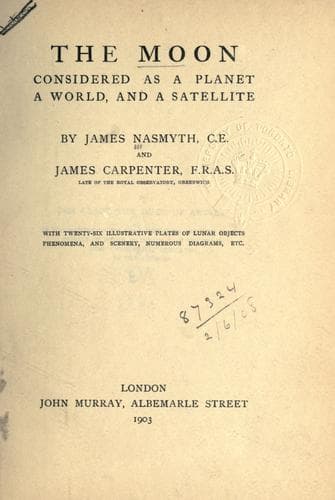
The Moon: considered as a planet, a world, and a satellite.Nasmyth, James
Science
The Moon: considered as a planet, a world, and a satellite.
Nasmyth, James
Moon
That the moon is not a smooth sphere of matter is a fact that manifested
itself to the earliest observers. The naked eye perceives on her face
spots exhibiting marked differences of illumination. These variations of
light and shade, long before the invention of the telescope, induced the
belief that she possessed surface irregularities like those that
diversify the face of the earth, and from analogy it was inferred that
seas and continents alternated upon the lunar globe. It was evident,
from the persistence and invariability of the dusky markings, that they
were not due to atmospheric peculiarities, but were veritable variations
in the character or disposition of the surface material. Fancy made
pictures of these unchangeable spots: untutored gazers detected in them
the indications of a human countenance, and perhaps the earliest map of
the moon was a rough reproduction of a man’s face, the eyes, nose and
mouth representing the more salient spots discernible upon the lunar
disc. Others recognised in these spots the configuration of a human
form, head, arms and legs complete, which a French superstition that
lingers to the present day held to be the image of Judas Iscariot
transported to the moon in punishment for his treason. Again, an Indian
notion connects the lunar spots with a representation of a roebuck or a
hare, and hence the Sanskrit names for the moon, _mrigadhara_, a
roebuck-bearer, and _’sa’sabhrit_, a hare-bearer. Of these similitudes
the one which has the best pretensions to a rude accuracy is that first
mentioned; for the resemblance of the full moon to a human countenance,
wearing a painful or lugubrious expression, is very striking. Our
illustration of the full moon (Plate III.) is derived from an actual
photograph;[4] the relative intensities of light and shade are hence
somewhat exaggerated; otherwise it represents the full moon very nearly
as the naked eye sees it, and by gazing at the plate from a short
distance,[5] the well-known features will manifest themselves, while
they who choose may amuse themselves by arranging the markings in their
imagination till they conform to the other appearances alluded to.
Public-domain text, read in full here on John Shaqi.
Reviews
Reviews
No reviews yet
Be the first to share your thoughts on this work.
Elsewhere in the archive
Join the Discussion
Join the discussion
Sign in to leave a comment or review.
Sign InorCreate an account