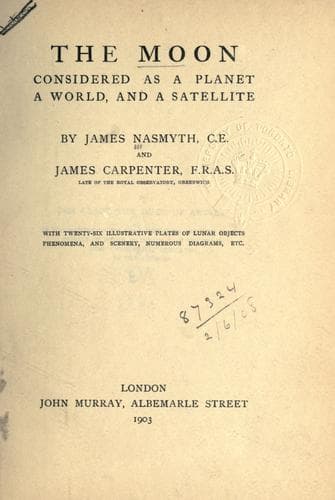
The Moon: considered as a planet, a world, and a satellite.Nasmyth, James
Science
The Moon: considered as a planet, a world, and a satellite.
Nasmyth, James
Moon
We may remark in passing that by one sect of ancient writers the moon
was supposed to be a kind of mirror, receiving the image of the earth
and reflecting it back to terrestrial spectators. Humboldt affirmed that
this opinion had been preserved to his day as a popular belief among the
people of Asia Minor. He says, “I was once very much astonished to hear
a very well educated Persian from Ispahan, who certainly had never read
a Greek book, mention when I showed him the moon’s spots in a large
telescope in Paris, this hypothesis as a widely diffused belief in his
country: ‘What we see in the moon,’ said the Persian, ‘is ourselves; it
is the map of our earth.’” Quite as extravagant an idea, though perhaps
a more excusable one, was that held by some ancient philosophers, to the
effect that the spots on the moon were the shadows of opaque bodies
floating in space between it and the sun.
[Illustration: PLATE III.
FULL MOON.]
An observer watching the forms and positions of the lunar face-marks,
from night to night and from lunation to lunation, cannot fail to notice
the circumstance that they undergo no easily perceptible change of
position with respect to the circular outline of the disc; that in fact
the face of the moon presented to our view is always the same, or very
nearly so. If the moon had no orbital motion we should be led from the
above phenomenon to conclude that she had no axial motion, no movement
of rotation; but when we consider the orbital motion in connection with
the permanence of aspect, we are driven to the conclusion—one, however,
which superficial observers have some difficulty in recognising—that the
moon has an axial rotation equal in period to her orbital revolution.
Since the moon makes the circuit of her orbit in twenty-seven days and
one-third (more exactly 27d. 7h. 43m. 11s.) it follows that this is the
time of her axial rotation, as referred to the stars, or as it would be
made out by an observer located at a fixed position in space outside the
lunar orbit. But if referred to the sun this period appears different;
because the moon while revolving round the earth is, with the earth,
circulating around the sun. Suppose the three bodies, moon, earth, and
sun, to be in a line at a certain period of a lunation, as they are at
full moon: by the time the moon has completed her twenty-seven days’
journey around the earth, the latter will have moved along twenty-seven
days’ march of its orbit, which is about twenty-seven degrees of
celestial longitude: the sun will apparently be that much distant from a
straight line passing through earth and moon, and the moon must
therefore move forward to overtake the sun before she can assume the
full phase again. She will take something over two days to do this;
hence the solar period of her revolution becomes more than twenty-nine
days (to be exact, 29d. 12h. 44m. 2s. ·87). This is the length of a
solar day upon the moon—the interval from one sunrise to another at any
Public-domain text, read in full here on John Shaqi.
Reviews
Reviews
No reviews yet
Be the first to share your thoughts on this work.
Elsewhere in the archive
Join the Discussion
Join the discussion
Sign in to leave a comment or review.
Sign InorCreate an account