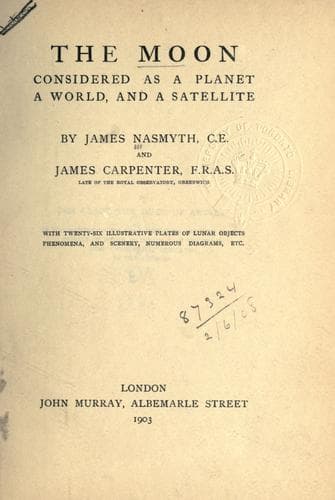
The Moon: considered as a planet, a world, and a satellite.Nasmyth, James
Science
The Moon: considered as a planet, a world, and a satellite.
Nasmyth, James
Moon
spot upon the equator of our satellite, and the interval between
successive reappearances of the same phase to observers on the earth.
The physical cause of the coincidence of times of rotation and
revolution was touched upon in a previous chapter.
We have said that the moon continuously presents to us the same
hemisphere. This is generally true, but not entirely so. Galileo, by
long scrutiny, familiarised himself with every detail of the lunar-disc
that came within the limited grasp of his telescopes, and he recognised
the fact that according as the position of the moon varied in the sky,
so the aspect of her face altered to a slight degree; that certain
regions at the edge of her disc, alternately came in sight and receded
from his view. He perceived, in fact, an _apparent_ rocking to and fro
of the globe of the moon; a sort of balancing or _libratory_ motion.
When the moon was near the horizon he could see spots upon her uppermost
edge, which disappeared as she approached the zenith, or highest point
of her nightly path; and as she neared this point, other spots, before
invisible, came into view, near to what had been her lower edge. Galileo
was not long in referring this phenomenon to its true cause. The centre
of motion of the moon being the centre of the earth, it is clear that an
observer on the surface of the latter, looks down upon the rising moon
as from an eminence, and thus he is enabled to see more or less over or
around her. As the moon increases in altitude, the line of sight
gradually becomes parallel to the line joining the observer and the
centre of the earth, and at length he looks her full in the face: he
loses the full view and catches another side face view as she nears the
horizon in setting. This phenomenon, occurring as it does, with a daily
period, is known as the _diurnal libration_.
But a kindred phenomenon presents itself in another period, and from
another cause. The moon rotates upon her axis at a speed that is
rigorously uniform. But her orbital motion is not uniform, sometimes it
is faster, and at other times slower than its average rate. Hence, the
angle through which she moves along her orbit in a given time, now
exceeds, and now falls short of the angle through which she turns upon
her axis. Her visible hemisphere thus changes to an extent depending
upon the difference between these orbital and axial angles, and the
apparent balancing thus produced is called the _libration in longitude_.
Then there is a _libration in latitude_ due to the circumstance that the
axis of the moon is not exactly perpendicular to the plane of her orbit;
the effect of this inclination being, that we sometimes see a little
more of the north than of the south polar regions of our satellite, and
_vice versâ_.[6]
Public-domain text, read in full here on John Shaqi.
Reviews
Reviews
No reviews yet
Be the first to share your thoughts on this work.
Elsewhere in the archive
Join the Discussion
Join the discussion
Sign in to leave a comment or review.
Sign InorCreate an account