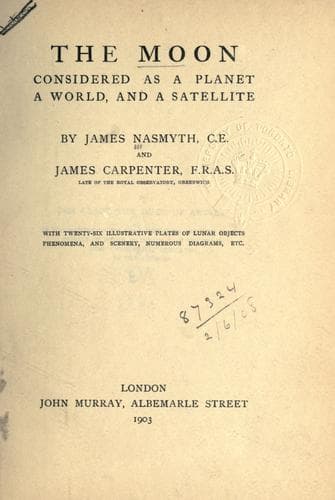
The Moon: considered as a planet, a world, and a satellite.Nasmyth, James
Science
The Moon: considered as a planet, a world, and a satellite.
Nasmyth, James
Moon
The extent of the moon’s librations, taking them all and in combination
into account, amounts to about seven degrees of arc of latitude or
longitude upon the moon, both in the north-south and east-west
directions. And taking into account the whole effect of them, we may
conclude that our view of the moon’s surface, instead of being confined
to one half, is extended really to about four-sevenths of the whole area
of the lunar globe. The remaining three-sevenths must for ever remain a
_terra incognita_ to the habitants of this earth, unless, indeed, from
some catastrophe which it would be wild fancy to anticipate, a period of
rotation should be given to the moon different from that which it at
present possesses. Some highly fanciful theorists have speculated upon
the possible condition of the invisible hemisphere, and have propounded
the absurd notion that the opposite side of the moon is hollow, or that
the moon is a mere shell; others again have urged that the hidden half
is more or less covered with water, and others again that it is peopled
with inhabitants. There is, however, no good reason for supposing that
what we may call the back of the moon has a physical structure
essentially different from the face presented towards us. So far as can
be judged from the peeps that libration enables us to obtain, the same
characteristic features (though of course with different details)
prevail over the whole lunar surface.
The speculative ideas held by the philosophers of the pre-telescopic
age, touching the causes which produced the inequalities of light and
shade upon the moon, received their _coup de grâce_ from the revelations
of Galileo’s glasses. Our satellite was one of the earliest objects, if
not actually the first, upon which the Florentine turned his telescope;
and he found that the inequalities upon her surface were due to
differences in its configuration analogous to the continents and
islands, and (as might then have been thought) the seas of our globe. He
could trace, even with his moderate means, the semblance of
mountain-tops upon which the sun shone while their lower parts were in
shadow, of hills that were brightly illuminated upon their sides towards
the sun, of brightly shining elevations, and deeply shadowed
depressions, of smooth plains, and regions of mountainous ruggedness. He
saw that the boundary of sunlight upon the moon was not a clearly
defined line, as it would be if the lunar globe were a smooth sphere, as
the Aristotelians had asserted, but that the terminator was uneven and
broken into an irregular outline. From these observations the Florentine
astronomer concluded that the lunar world was covered not only with
mountains like our globe, but with mountains whose heights far surpassed
those existing upon the earth, and whose forms were strangely limited to
circularity.
Public-domain text, read in full here on John Shaqi.
Reviews
Reviews
No reviews yet
Be the first to share your thoughts on this work.
Elsewhere in the archive
Join the Discussion
Join the discussion
Sign in to leave a comment or review.
Sign InorCreate an account