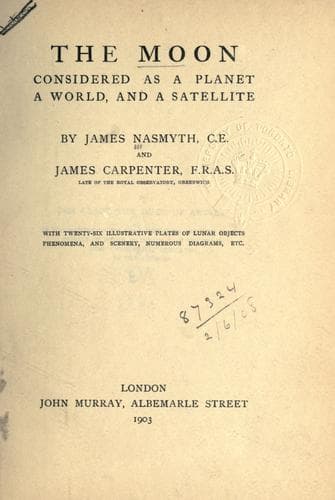
The Moon: considered as a planet, a world, and a satellite.Nasmyth, James
Science
The Moon: considered as a planet, a world, and a satellite.
Nasmyth, James
Moon
Galileo’s best telescopes magnified only some thirty times, and the
views which he thus obtained, must have been similar to those exhibited
by the smaller photographs of the moon produced in late years by Mr. De
la Rue and now familiar to the scientific public. Of course there is in
the natural moon as viewed with a small telescope a vivid brilliancy
which no art can imitate, and in photographs especially there is a
tendency to exaggeration of the depths of shade in a lunar picture. This
arises from the circumstance that various regions of the moon do not
impress a chemically sensitized plate as they impress the retina of the
eye. Some portions, notably the so-called “seas” of the moon, which to
the eye appear but slightly duller than the brighter parts, give off so
little _actinic_ light that they appear as nearly black patches upon a
photograph, and thus give an undue impression of the relative brightness
of various parts of the lunar surface. Doubtless by sufficient exposure
of the plate in the camera-telescope the dark patches might be rendered
lighter, but in that case the more strongly illuminated portions, which
after all are those most desirable to be preserved, would be lost by the
effect which photographers understand as “solarization.”
In speaking of a view of the moon with a magnifying power of thirty, it
is necessary to bear in mind that the visible features will differ
considerably with the diameter of the object-glass of the telescope to
which this power is applied. The same details would not be seen alike
with the same power upon an object-glass of 10 inches diameter and one
of 2 inches. The superior illumination of the image in the former case
would bring into view minute details that could not be perceived with
the smaller aperture. He who would for curiosity wish to see the moon,
or any other object, as Galileo saw it, must use a telescope of the same
size and character in all respects as Galileo’s: it will not do to put
his magnifying power upon a larger telescope. With large telescopes, and
low powers used upon bright objects like the moon, there is a blinding
flood of light which tends to contract the pupil of the eye and prevent
the passage of the whole of the pencil of rays coming through the
eye-piece. Although this last result may be productive of no
inconvenience, it is clearly a waste of light, and it points to a rule
that the lowest power that a telescope should bear is that which gives a
pencil of light equal in diameter to the pupil of the eye under the
circumstances of brightness attendant upon the object viewed. In
observing faint objects this point assumes more importance, since it is
then necessary that all available light should enter the pupil. The
thought suggests itself that an artificial enlargement of the pupil, as
by a dose of belladonna, might be of assistance in searching for faint
objects, such as nebulæ and comets: but we prefer to leave the
Public-domain text, read in full here on John Shaqi.
Reviews
Reviews
No reviews yet
Be the first to share your thoughts on this work.
Elsewhere in the archive
Join the Discussion
Join the discussion
Sign in to leave a comment or review.
Sign InorCreate an account