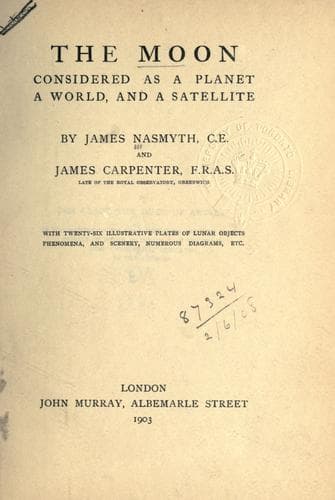
The Moon: considered as a planet, a world, and a satellite.Nasmyth, James
Science
The Moon: considered as a planet, a world, and a satellite.
Nasmyth, James
Moon
disembarrass the stores of that establishment, by ridding them of what
he considered lumber! La Hire, Mayer, and Lambert, followed during the
succeeding century, in this branch of astronomical delineation. At the
commencement of the present century, the subject was very earnestly
taken up by the indefatigable Schroeter, who, although he does not
appear to have produced a complete map, produced a topograph of the moon
in a large series of partial maps and drawings of special features.
Schroeter was a fine observer, but his delineations show him to have
been an indifferent draughtsman. Some of his drawings are but the rudest
representations of the objects he intended to depict; many of the bolder
features of conspicuous objects are scarcely recognizable in them. A bad
artist is as likely to mislead posterity as a bad historian, and it
cannot be surprising if observers of this or future generations,
accepting Schroeter’s drawings as faithful representations, should infer
from them remarkable changes in the lunar details. It is much to be
regretted that Schroeter’s work should be thus depreciated. Lohrman of
Dresden, was the next cartographer of the moon; in 1824 he put forth a
small but very excellent map of 15 inches diameter, and published a book
of descriptive text, accompanied by sectional charts of particular
areas. His work, however, was eclipsed by the great one which we owe to
the joint energy of MM. Beer and Maedler, and which represents a
stupendous amount of observing work carried on during several years
prior to 1836, the date of their publication. The long and patient
labour bestowed upon their map and upon the measures on which it
depends, deserve the highest praise which those conversant with the
subject can bestow, and it must be very long before their efforts can be
superseded.
Beer and Maedler’s map has a diameter of 37 inches: it represents the
phase of the moon visible in the condition of mean libration. The
details were charted by a careful process of triangulation. The disc was
first divided into “triangles of the first order,” the points of which
(conspicuous craters) were accurately laid down by reference to the
edges of the disc: one hundred and seventy-six of these triangles,
plotted accurately upon an orthographic projection of the hemisphere,
formed the reliable basis for their charting work. From these a great
number of “points of the second order” were laid down, by measuring
their distance and angle of position with regard to points first
established. The skeleton map thus obtained was filled up by drawings
made at the telescope: the diameters of the measureable craters being
determined by the micrometer.
Public-domain text, read in full here on John Shaqi.
Reviews
Reviews
No reviews yet
Be the first to share your thoughts on this work.
Elsewhere in the archive
Join the Discussion
Join the discussion
Sign in to leave a comment or review.
Sign InorCreate an account