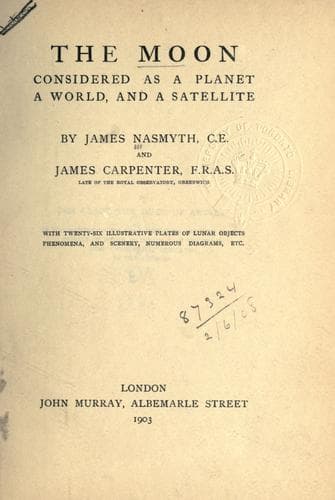
The Moon: considered as a planet, a world, and a satellite.Nasmyth, James
Science
The Moon: considered as a planet, a world, and a satellite.
Nasmyth, James
Moon
The strong family likeness pervading the craters of the moon renders it
unnecessary that we should attempt a description of each one of them or
even of one in twenty. We have, however, thought that a few remarks upon
the salient features of a few of the most important may be acceptable in
explanation of our illustrative plates; and what we have to say of the
few may be taken as representative of the many.
COPERNICUS, 147—(49·8—107·0). Plate VIII.
This may deservedly be considered as one of the grandest and most
instructive of lunar craters. Although its vast diameter (46 miles) is
exceeded by others, yet, taken as a whole, it forms one of the most
impressive and interesting objects of its class. Its situation, near the
centre of the lunar disc, renders all its wonderful details, as well as
those of its immediately surrounding objects, so conspicuous as to
establish it as a very favourite object. Its vast rampart rises to
upwards of 12,000 feet above the level of the plateau, nearly in the
centre of which stands a magnificent group of cones, three of them
attaining the height of upwards of 2400 feet.
The rampart is divided by concentric segmental terraced ridges, which
present every appearance of being enormous landslips, resulting from the
crushing of their over-loaded summits, which have slid down in vast
segments and scattered their débris on to the plateau. Corresponding
vacancies in the rampart may be observed from whence these prodigious
masses have broken away. The same may be noticed, although in a somewhat
modified degree, around the exterior of the rampart. In order to
approach a realization of the sublimity and grandeur of this magnificent
example of a lunar volcanic crater, our reader would do well to
endeavour to fix his attention on its enormous magnitude and attempt to
establish in his mind’s eye a correct conception of the scale of its
details as well as its general dimensions, which, as they so
prodigiously transcend those of the largest terrestrial volcanic
craters, require that our ideas as to magnitude of such objects should
be, so to speak, educated upon a special standard. It is for this reason
we are anxious our reader, when examining our illustrations, should
constantly refer the objects represented in them to the scale of miles
appended to each plate, otherwise a just and true conception of the
grandeur of the objects will escape him.
Public-domain text, read in full here on John Shaqi.
Reviews
Reviews
No reviews yet
Be the first to share your thoughts on this work.
Elsewhere in the archive
Join the Discussion
Join the discussion
Sign in to leave a comment or review.
Sign InorCreate an account