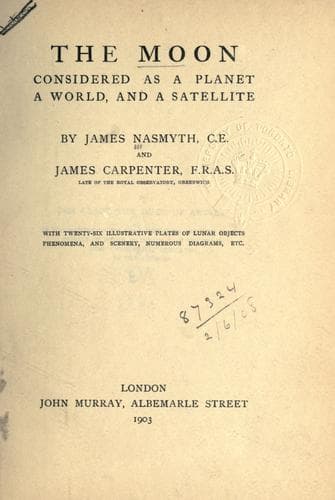
The Moon: considered as a planet, a world, and a satellite.Nasmyth, James
Science
The Moon: considered as a planet, a world, and a satellite.
Nasmyth, James
Moon
Copernicus is specially interesting, as being evidently the result of a
vast discharge of molten matter which has been ejected at the focus or
centre of disruption of an extensively upheaved portion of the lunar
crust. A careful examination of the crater and the district around it,
even to the distance of more than 100 miles on every side, will supply
unmistakable evidence of the vast extent and force of the original
disruption, manifested by a wonderfully complex reticulation of bright
streaks which diverge in every direction from the crater as their common
centre. These streaks do not appear on our plate, nor are they seen upon
the moon except at and near the full phase. They show conspicuously,
however, by their united lustre on the full moon, Plate III. Every one
of those bright streaks, we conceive, is a record of what was originally
a crack or chasm in the solid crust of the moon, resulting from some
vastly powerful upheaving agency over the site of whose focus of energy
Copernicus stands. The cracking of the crust must have been followed by
the ejection of subjacent molten matter up through the reticulated
cracks; this, spreading somewhat on either side of them, has left these
bright streaks as a visible record of the force and extent of the
upheaval; while at the focus of disruption from whence the cracks
diverge, the grand outburst appears to have taken place, leaving
Copernicus as its record and result.
Many somewhat radial ridges or spurs may be observed leading away from
the exterior banks of the great rampart. These appear to be due to the
more free egress which the extruded matter would find near the focus of
disruption. The spur-ridges may be traced fining away for fully 100
miles on all sides, until they become such delicate objects as to
approach invisibility. Several vast open chasms or cracks may be
observed around the exterior of the rampart. They appear to be due to
some action subsequent to the formation of the great crater—probably the
result of contraction on the cooling of the crust, or of a deep-seated
upheaval long subsequent to that which resulted in the formation of
Copernicus itself, as they intersect objects of evidently prior
formation.
Under circumstances specially favourable for “fine vision,” for upwards
of 70 miles on all sides around Copernicus, myriads of comparatively
minute but perfectly-formed craters may be observed. The district on the
south-east side is specially rich in these wonderfully thickly-scattered
craters, which we have reason to suppose stand over or upon the
reticulated bright streaks; but, as the circumstances of illumination
which are requisite to enable us to detect the minute craters are widely
adverse to those which render the bright streaks visible, namely, nearly
full moon for the one and gibbous for the other, it is next to
impossible to establish the fact of coincidence of the sites of the two
by actual simultaneous observation.
Public-domain text, read in full here on John Shaqi.
Reviews
Reviews
No reviews yet
Be the first to share your thoughts on this work.
Elsewhere in the archive
Join the Discussion
Join the discussion
Sign in to leave a comment or review.
Sign InorCreate an account