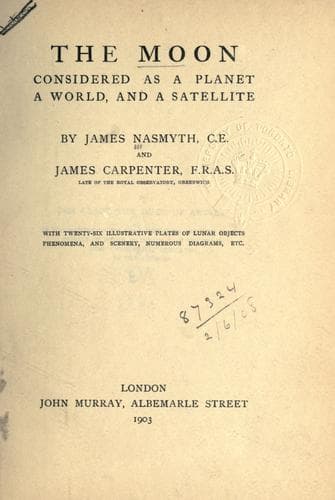
The Moon: considered as a planet, a world, and a satellite.Nasmyth, James
Science
The Moon: considered as a planet, a world, and a satellite.
Nasmyth, James
Moon
At the east side of the rampart, multitudes of these comparatively
minute craters may also be detected, although not so closely crowded
together as those on the west side; but among those on the east may be
seen myriads of minute prominences roughening the surface; on close
scrutiny these are seen to be small mounds of extruded matter which, not
having been ejected with sufficient energy to cause the erupted material
to assume the crater form around the vent of ejection, have simply
assumed the mound form so well known to be the result of volcanic
ejection of moderate force.
Were we to select a comparatively limited portion of the lunar surface
abounding in the most unmistakable evidence of volcanic action in every
variety that can characterize its several phases, we could not choose
one yielding in all respects such instructive examples as Copernicus and
its immediate surroundings.
GASSENDI, 90—(59·7—123·3). Frontispiece.
An interesting crater about 54 miles diameter; the height of the most
elevated portion of the surrounding wall from the plateau being about
9600 feet. The centre is occupied by a group of conical mountains, three
of which are most conspicuous objects and rise to nearly 7000 feet above
the level of the plateau. As in other similar cases, these central
mountains are doubtless the result of the expiring effort of the
eruption which had formed the great circular wall of the crater. The
plateau is traversed by several deep cracks or chasms nearly one mile
wide.
Both the interior and exterior of the wall of the crater are terraced
with the usual segmental ridges or landslips. A remarkable detached
portion of the interior bank is to be seen on the east side, while on
the west exterior of the wall may be seen an equally remarkable example
of an outburst of lava subsequent to the formation of the wall or bank
of the crater; it is of conical form and cannot fail to secure the
attention of a careful observer.
Interpolated on the north wall of the crater may be seen a crater of
about 18 miles diameter which has burst its bank in towards the great
crater, upon whose plateau the lava appears to have discharged itself.
The neighbourhood of Gassendi is diversified by a vast number of mounds
and long ridges of exudated matter, and also traversed by enormous
chasms and cracks, several of which exceed one mile wide and are fully
100 miles in length, and, as is usual with such cracks, traverse plain
and mountain alike, disregarding all surface inequalities.
Numbers of small craters are scattered around; the whole forming an
interesting and instructive portion of the lunar surface.
EUDOXUS, 208 (29·7—88·0), and ARISTOTLE, 209 (30·0—84·6). Plate X.
Public-domain text, read in full here on John Shaqi.
Reviews
Reviews
No reviews yet
Be the first to share your thoughts on this work.
Elsewhere in the archive
Join the Discussion
Join the discussion
Sign in to leave a comment or review.
Sign InorCreate an account