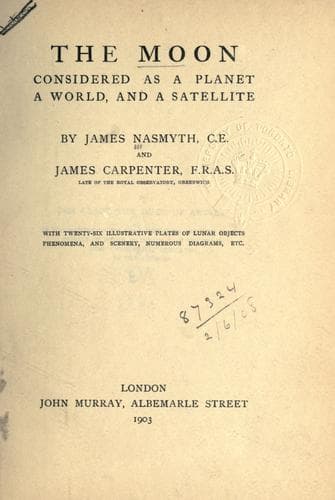
The Moon: considered as a planet, a world, and a satellite.Nasmyth, James
Science
The Moon: considered as a planet, a world, and a satellite.
Nasmyth, James
Moon
PICO, 211 (41·9—87·3). Plate XIV.
This is one of the most interesting examples of an isolated volcanic
“mountain of exudation,” and it forms a very striking object when seen
under favourable circumstances. Its height is upwards of 8000 feet, and
it is about three times as long at the base as it is broad. The summit
is cleft into three peaks, as may be ascertained by the three-peaked
shadow it casts on the plain. Five or six minute craters of very perfect
form may be detected close to the base of this magnificent mountain.
There are several other isolated peaks or mountains of the same class
within 30 or 40 miles of it which are well worthy of careful scrutiny,
but Pico is the master of the situation, and offers a glorious subject
for realizing a lunar day-dream in the mind’s eye, if we can only by an
effort of imagination conceive its aspect under the fiercely brilliant
sunshine by which it is illuminated, contrasted with the intensely black
lunar heavens studded with stars shining with a steady brightness of
which, by reason of _our_ atmosphere intervening, we can have no
adequate conception save by the aid of a well-directed imagination.
TYCHO, 30 (43·0—142·3). Plate XVI.
This magnificent crater, which occupies the centre of the crowded group
in our Plate, is 54 miles in diameter, and upwards of 16,000 feet deep,
from the highest ridge of the rampart to the surface of the plateau,
whence rises a grand central cone 5000 feet high. It is one of the most
conspicuous of all the lunar craters, not so much on account of its
dimensions as from its occupying the great focus of disruption from
whence diverge those remarkable bright streaks, many of which may be
traced over 1000 miles of the moon’s surface, disregarding in their
course all interposing obstacles. There is every reason to conclude that
Tycho is an instance of a vast disruptive action which rent the solid
crust of the moon into radiating fissures, which were subsequently
occupied by extruded molten matter, whose superior luminosity marks the
course of the cracks in all directions from the crater as their common
centre of divergence. So numerous are these bright streaks when examined
by the aid of the telescope, and they give to this region of the moon’s
surface such an extra degree of luminosity, that, when viewed as a
whole, their locality can be distinctly seen at full moon by the
unassisted eye as a bright patch of light on the southern portion of the
disc. (See Plate III.) The causative origin of the streaks is discussed
and illustrated in Chapter XI.
Public-domain text, read in full here on John Shaqi.
Reviews
Reviews
No reviews yet
Be the first to share your thoughts on this work.
Elsewhere in the archive
Join the Discussion
Join the discussion
Sign in to leave a comment or review.
Sign InorCreate an account