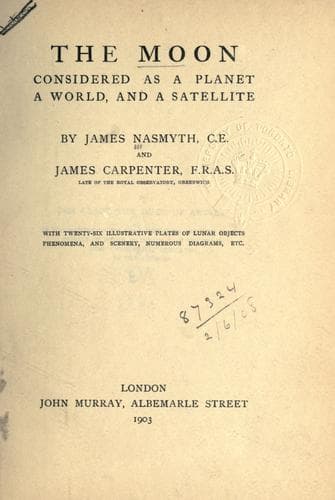
The Moon: considered as a planet, a world, and a satellite.Nasmyth, James
Science
The Moon: considered as a planet, a world, and a satellite.
Nasmyth, James
Moon
The interior of this fine crater presents striking examples of the
concentric terrace-like formations that we have elsewhere assigned to
vast landslip actions. Somewhat similar concentric terraces may be
observed in other lunar craters; some of these, however, appear to be
the results of some temporary modification of the ejective force, which
has caused the formation of more or less perfect inner ramparts: what we
conceive to be true landslip terraces are always distinguished from
these by their more or less fragmentary character.
On reference to Plate III., showing the full moon, a very remarkable and
special appearance will be observed in a dingy district or zone
immediately surrounding the exterior of the rampart of Tycho, and of
which we venture to hazard what appears to us a rational explanation:
namely, that as Tycho may be considered to have acted as a sort of
safety-valve to the rending and ejective force which caused, in the
first instance, the cracking of this vast portion of the moon’s
crust—the molten matter that appears to have been forced up through
these cracks, on finding a comparatively free exit by the vent of Tycho,
so relieved the district immediately around him as to have thereby
reduced, in amount, the exit of the molten matter, and so left a zone
comparatively free from the extruded lava which, according to our view
of the subject, came up simultaneously through the innumerable fissures,
and, spreading sideways along their courses, left everlasting records of
the original positions of the radiating cracks in the form of the bright
streaks which we now behold.
“WARGENTIN,” 26 (57·5—140·2). Plate XVII.
This object is quite unique of its kind—a crater about 53 miles across
that to all appearance has been filled to the brim with lava that has
been left to consolidate. There are evidences of the remains of a
rampart, especially on the south-west portion of the rim. The general
aspect of this extraordinary object has been not unaptly compared to a
“thin cheese.” The terraced and rutted exterior of the rampart has all
the usual characteristic details of the true crater. The surface of the
high plateau is marked by a few ridges branching from a point nearly in
its centre, together with some other slight elevations and depressions;
these, however, can only be detected when the sun’s rays fall nearly
parallel to the surface of the plateau.
To the north of this interesting object is the magnificent ring
formation Schickard, whose vast diameter of 123 miles contrasts
strikingly with that of the sixteen small craters within his rampart,
and equally so with a multitude of small craters scattered around. There
are many objects of interest on the portion of the lunar surface
included within our illustration, but as they are all of the usual type,
we shall not fatigue the attention of our readers by special
descriptions of them.
ARISTARCHUS, 176 (6·3—99·2), and HERODOTUS, 175 (63·2—99·6). Plate XVIII.
Public-domain text, read in full here on John Shaqi.
Reviews
Reviews
No reviews yet
Be the first to share your thoughts on this work.
Elsewhere in the archive
Join the Discussion
Join the discussion
Sign in to leave a comment or review.
Sign InorCreate an account