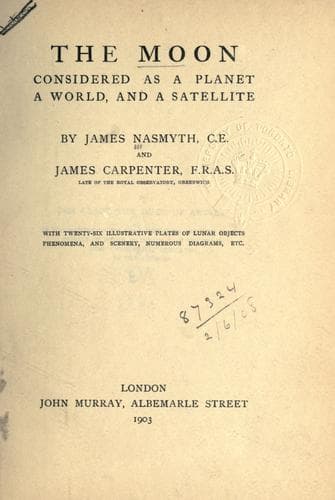
The Moon: considered as a planet, a world, and a satellite.Nasmyth, James
Science
The Moon: considered as a planet, a world, and a satellite.
Nasmyth, James
Moon
Archimedes is the largest crater in the group; it has a diameter of
upwards of 52 miles, measuring from summit to summit of its vast
circular rampart or crater wall, the average height of which, above the
plateau, is about 4300 feet; but some parts of it rise considerably
higher, and, in consequence, cast steeple-like shadows across the
plateau when the sun’s rays are intercepted by them at a low angle. The
plateau of this grand crater is devoid of the usual central cone. Two
comparatively minute but beautifully-formed craters may be detected
close to the north-east interior side of the surrounding wall of the
great crater. Both outside and inside of the crater wall may be seen
magnificent examples of the landslip subsidence of its overloaded banks;
these landslips form vast concentric segments of the outer and inner
circumference of the great circular rampart, and doubtless belong to its
era of formation. Two very fine examples of cracks, or chasms, may be
observed proceeding from the opposite external sides of the crater, and
extending upwards of 100 miles in each direction; these cracks, or
chasms, are fully a mile wide at their commencement next the crater, and
narrow away to invisibility at their further extremity. Their course is
considerably crooked, and in some parts they are partially filled by
masses of the material of their sides, which have fallen inward and
partially choked them. The depths of these enormous chasms must be very
great, as they probably owe their existence to some mighty upheaving
action, which there is every reason to suppose originated at a profound
depth, since the general surface on each side of the crater does not
appear to be disturbed as to altitude, which would have been the case
had the upheaving action been at a moderate depth beneath. We would
venture to ascribe a depth of not less than ten miles as the most
moderate estimate of the profundity of these terrible chasms. If the
reader would realize the scale of them, let him for a moment imagine
himself a traveller on the surface of the moon coming upon one of them,
and finding his onward progress arrested by the sudden appearance of its
vast black yawning depths; for by reason of the angle of his vision
being almost parallel to the surface, no appearance of so profound a
chasm would break upon his sight until he came comparatively close to
its fearful edge. Our imaginary lunar traveller would have to make a
very long détour, ere he circumvented this terrible interruption to his
progress. If the reader will only endeavour to realize in his mind’s eye
the terrific grandeur of a chasm a mile wide and of such dark profundity
as to be, to all appearance, fathomless—portions of its rugged sides
fallen in wild confusion into the jaws of the tortuous abyss, and
catching here and there a ray of the sun sufficient only to render the
darkness of the chasm more impressive as to its profundity—he will, by
Public-domain text, read in full here on John Shaqi.
Reviews
Reviews
No reviews yet
Be the first to share your thoughts on this work.
Elsewhere in the archive
Join the Discussion
Join the discussion
Sign in to leave a comment or review.
Sign InorCreate an account