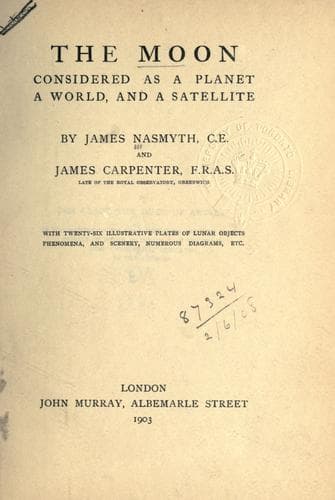
The Moon: considered as a planet, a world, and a satellite.Nasmyth, James
Science
The Moon: considered as a planet, a world, and a satellite.
Nasmyth, James
Moon
There are no features about Herodotus of any such speciality as to call
for remark, except it be the breach of the north side of its rampart by
the southern extremity of a very remarkable contorted crack or chasm,
which to all appearance owes its existence to some great disruptive
action subsequent to the formation of the crater.
WALTER, 48 (37·8—131·9), and adjacent Intrusive Craters. Plate XX.
This Plate represents a southern portion of the moon’s surface measuring
170 by 230 miles. It includes upwards of 200 craters of all dimensions,
from Walter, whose rampart measures nearly 70 miles across, down to
those of such small apparent diameter as to require a well practized eye
to detect them. In the interior of the great crater Walter a remarkable
group of small craters may be observed surrounding his central cone,
which in this instance is not so perfectly in the centre of the rampart
as is usually the case. The number of small craters which we have
observed within the rampart is 20, exclusive of those on the rampart
itself. The entire group represented in the Plate suggests in a striking
manner the wild scenery which must characterize many portions of the
lunar surface; the more so if we keep in mind the vast proportions of
the objects which they comprise, upon which point we may remark that the
smallest crater represented in this Plate is considerably larger than
that of Vesuvius.
ARCHIMEDES, 191 (40·3—95·8), AUTOLYCUS, 189 (36·8—95·5), ARISTILLUS,
190 (37·0—93·3), and the APENNINES. Plate IX.
This group of three magnificent craters, together with their remarkable
surroundings, especially including the noble range of mountains termed
the Apennines, forms on the whole one of the most striking and
interesting portions of the lunar surface. If the reader is not
acquainted with what the telescope can reveal as to the grandeur of the
effect of sunrise on this very remarkable portion of the moon’s surface,
he should carefully inspect and study our illustration of it; and if he
will pay due regard to our previously repeated suggestion concerning the
attached scale of miles, he will, should he have the good fortune to
study the actual objects by the aid of a telescope, be well prepared to
realize and duly appreciate the magnificence of the scene which will be
presented to his sight.
Were we to attempt an adequate detail description of all the interesting
features comprised within our illustration, it would, of itself, fill a
goodly volume; as there is included within the space represented every
variety of feature which so interestingly characterizes the lunar
surface. All the more prominent details are types of their class; and
are so favourably situated in respect to almost direct vision, as to
render their nature, forms, and altitudes above and depths below the
average surface of the moon most distinctly and impressively cognizable.
Public-domain text, read in full here on John Shaqi.
Reviews
Reviews
No reviews yet
Be the first to share your thoughts on this work.
Elsewhere in the archive
Join the Discussion
Join the discussion
Sign in to leave a comment or review.
Sign InorCreate an account