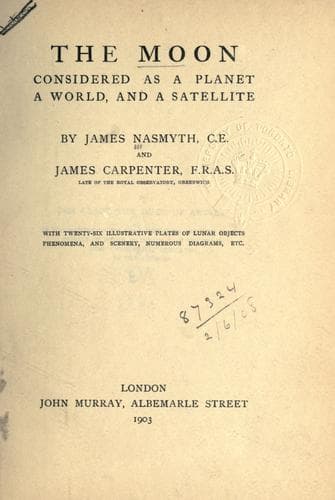
The Moon: considered as a planet, a world, and a satellite.Nasmyth, James
Science
The Moon: considered as a planet, a world, and a satellite.
Nasmyth, James
Moon
Now this form may have been assumed under two conditions. If, as
Phillips has surmised, the mountain originally had a peaked summit with
but a small crater-orifice at the point, then we must ascribe its
decapitation to a subsequent eruption which in its violence carried away
the upper portion, either suddenly, or through a comparatively slow
process of grinding away or widening out of the sides of the orifice by
the chafing or fluxing action of the out-going materials. But it is
probable that the mountain never had the perfect summit indicated in our
first outline. The violent outburst that caused the great crater-opening
of our second figure may have been but one paroxysmal phase of the
eruption that built the mountain: a sudden cessation of the eruptive
force when at its greatest intensity, and when the orifice was at its
widest, would leave matters in an opposite condition to that suggested
as the result of a slow dying out of the action: instead of the peak we
should have a wide crater-mouth. It is of small consequence for our
present purpose whether the crater was contemporaneous with the
primitive formation of the mountain, or whether it was formed centuries
afterwards by the blowing away of the mountain’s head; for upon the vast
scale of geological time, intervals such as those between successive
paroxysms of the same eruption, and those between successive eruptions,
are scarcely to be discriminated, even though the first be days and the
second centuries. We may remark that the widening of a crater by a
subsequent and probably more powerful eruption than that which
originally produced it is well established. We have only to glance at
the sketch, Fig. 18, of the outline of Vesuvius as it appeared between
the years A.D. 79 and 1631 to see how the old crater was enlarged by the
terrible Pompeian eruption of the first-mentioned year. Here we have a
crater ground and blown away till its original diameter of a mile and
three-quarters has been increased to nearly three miles. Scrope had no
hesitation in expressing his conviction that the external rings, such as
those of Santorin, St. Jago, St Helena, the Cirque of Teneriffe, the
Curral of Madeira, the cliff range that surrounds the island of Bourbon,
and others of similar form and structure, however wide the area they
enclose, are truly the “basal wrecks” of volcanic mountains that have
been blown into the air each by some eruption of peculiar paroxysmal
violence and persistence; and that the circular or elliptical basins
which they wholly or in part surround are in all cases true craters of
eruption.
Public-domain text, read in full here on John Shaqi.
Reviews
Reviews
No reviews yet
Be the first to share your thoughts on this work.
Elsewhere in the archive
Join the Discussion
Join the discussion
Sign in to leave a comment or review.
Sign InorCreate an account