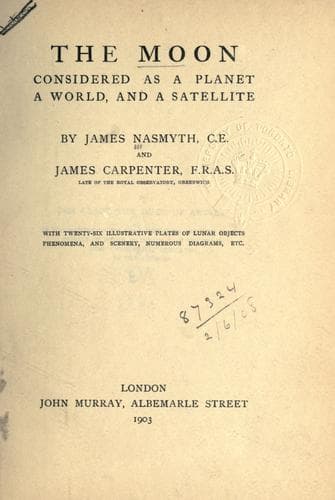
The Moon: considered as a planet, a world, and a satellite.Nasmyth, James
Science
The Moon: considered as a planet, a world, and a satellite.
Nasmyth, James
Moon
When the violent outburst that produces a great crater in a volcanic
mountain-top more or less completely subsides, the funnel or escaping
orifice becomes choked with débris. Still the vent strives to keep
itself open, and now and then gives out a small delivery of cindery
matter, which, being piled around the vent, after the manner of its
great prototype, forms the inner cone. This last may in its turn bear an
open crater upon its summit, and a still smaller cone may form within
_it_. As the action further dies away, the molten lava, no longer
seething and boiling, and spirting forth with the rest of the ejected
matter, wells upwards slowly, and cooling rapidly as it comes in contact
with the atmosphere, solidifies and forms a flat bottom or floor to the
crater.
[Illustration: Fig. 19.]
It may happen that a subsequent eruption from the original vent will be
comparable in violence to the original one, and then the inner cone
assumes a magnitude that renders it the principal feature of the
mountain, and reduces the old crater to a secondary object. This has
been the case with Vesuvius. During the eruption of 1631 the great cone
which we now call Vesuvius was thrown up, and the ancient crater now
distinguished as Monte Somma became a subsidiary portion of the whole
mountain. Then the appearance was that shown in Fig. 19, and which does
not differ greatly from that presented in the present day. The summit of
the Vesuvian cone, however, has been variously altered; it has been
blown away, leaving a large crateral hollow, and it has rebuilt itself
nearly upon its former model.
When we transfer our attention to the volcanoes of the moon, we find
ourselves not quite so well favoured with means for studying the process
of their formation; for the sight of the building up of a volcanic
mountain such as man has been permitted to behold upon the earth has not
been allowed to an observer of the moon. The volcanic activity,
enfeebled though it now be, of which we are witnesses from time to time
on the earth, has altogether ceased upon our satellite, and left us only
its effects as a clue to the means by which they were produced. If we in
our time could have seen the actual throwing up of a lunar crater, our
task of description would have been simple; as it is we are compelled to
infer the constructive action from scrutiny of the finished structure.
Public-domain text, read in full here on John Shaqi.
Reviews
Reviews
No reviews yet
Be the first to share your thoughts on this work.
Elsewhere in the archive
Join the Discussion
Join the discussion
Sign in to leave a comment or review.
Sign InorCreate an account