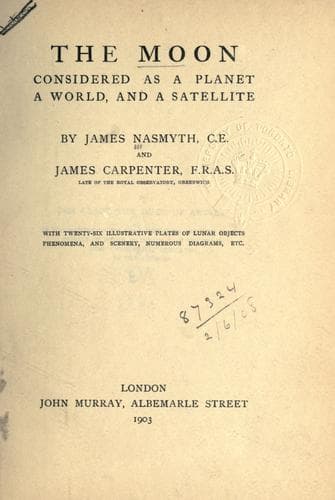
The Moon: considered as a planet, a world, and a satellite.Nasmyth, James
Science
The Moon: considered as a planet, a world, and a satellite.
Nasmyth, James
Moon
there was ample facility for their expansion.
While we are not insensible of the value of an expansive vapour
explanation, if it could be based on anything beyond mere conjecture, we
are disposed to attach greater weight to that afforded by the principle
sketched in our third chapter, viz., of expansion upon solidification.
We gave, as we think, ample proof that molten matter of volcanic nature,
when about passing to the solid state, increases its bulk to a
considerable degree, and we suggested that the lunar globe at one period
of its history must have been, what our earth is now, a solid shell
encompassing a molten nucleus; and further, that this last, in
approaching its solid condition, expanded and burst open or rent its
confining crust. At first sight it may seem that we are ascribing too
great a degree of energy to the expansive force which molten substances
exhibit in passing to the solid condition, seeing that in general such
forces are slow and gradual in their action; but this anomaly disappears
when we consider the vast bulk of the so expanding matter, and the
comparatively small amount that in its expansion it had to displace. It
is true that there are individual mountains on the moon covering many
square miles of surface, that as much as a thousand cubic miles of
material may have been thrown up at a single eruption; but what is this
compared to the entire bulk of the moon itself? A grain of mustard-seed
upon a globe three feet in diameter represents the scale of the loftiest
of terrestrial mountains; a similar grain upon a globe one foot in
diameter, would indicate the proportion of the largest upon the moon. A
model of our satellite with the elevations to scale would show nothing
more than a little roughness, or superficial blistering. Turn for a
moment to our map (Plate IV.), upon which the shadows give information
as to the heights of the various irregularities, and suppose it to
represent the actual size of some sphere whose surface has been broken
up by reactions of some kind of the interior upon the exterior—suppose
it to have been a globe of fragile material filled with some viscous
substance, and that this has expanded, cracked its shell, oozed out in
the process of solidification, and solidified: the irregularity of
surface which the small sphere, roughened by the out-leaking matter,
would present, would not be less than that exhibited in the map under
notice. When we say that a lunar crater has a diameter of 30 miles, we
raise astonishment that such a structure could result from an eruption
by the expansive force of solidifying matter; but when we reflect that
this diameter is less than the two-hundredth part of the circumference
of the moon, we need have no difficulty in regarding the upheaval as the
result of a force slight in comparison to the bulk of the material
giving rise to it. We have upon the moon evidence of volcanic eruptions
being the final result of most extensive dislocations of surface, such
Public-domain text, read in full here on John Shaqi.
Reviews
Reviews
No reviews yet
Be the first to share your thoughts on this work.
Elsewhere in the archive
Join the Discussion
Join the discussion
Sign in to leave a comment or review.
Sign InorCreate an account