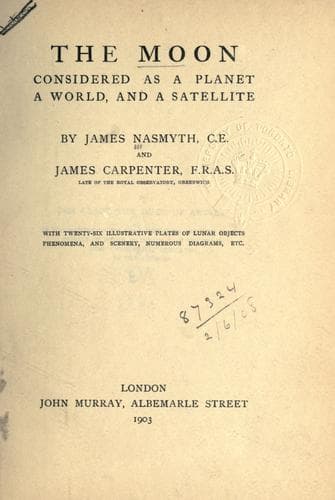
The Moon: considered as a planet, a world, and a satellite.Nasmyth, James
Science
The Moon: considered as a planet, a world, and a satellite.
Nasmyth, James
Moon
We can of course only conjecture the source or nature of the moon’s
volcanic force. If geologists have had difficulty in assigning an origin
to the power that threw up our earthly volcanoes, into whose craters
they can penetrate, whose processes they can watch, and whose material
they can analyze, how vastly more difficult must be the inquiry into the
primary source of the power that has been at work upon the moon, which
cannot be virtually approached by the eye within a distance of six or
eight hundred miles, and the material of which we cannot handle to see
if it be compacted by heat, or distended by vapours. Steam is the agent
to which geologists have been accustomed to look for explanation of
terrestrial volcanoes; the contact of water with the molten nucleus of
our globe is accepted as a probable means whereby volcanic commotions
are set up and ejective action is generated. But we are debarred from
referring to steam as an element of lunar geology, by reason of the
absence of water from the lunar globe. We might suppose that a small
proportion of water once existed; but a small proportion would not
account for the immense display of volcanic action which the whole
surface exhibits. If we admitted a Neptunian origin to the disturbances
of the moon’s crust, we should be compelled to suppose that water had
existed nearly in as great quantity, area for area, there as upon our
globe; but this we cannot reasonably do.
[Illustration: PLATE VIII.
COPERNICUS.]
Aqueous vapour being denied us, we must look in other directions for an
ejective force. Of the nature of the lunar materials we can know
nothing, and we might therefore assume anything; some have had recourse
to the supposition of expansive vapours given off by some volatile
component of the said material while in a state of fusion, or generated
by chemical combinations. Professor Dana refers to sulphur as probably
an important element in the moon’s geology, suggesting this substance
because of the part which it appears to play in the volcanic or igneous
operations of our globe, and on account of its presence in cosmical
meteors that have come within range of our analysis. Any matter
sublimated by heat in the substrata of the moon would be condensed upon
reaching the cold surrounding space, and would be deposited in a state
of fine powder, or otherwise in a solid form. Maedler has attributed the
highly reflective portions of some parts of the surface, such as the
bright streams that radiate from some of the craters, Copernicus and
Tycho for instance, to the vitrification of the surface matter by
gaseous currents. But in suppositions like these we must remember that
the probability of truth diminishes as the free ground for speculation
widens. It does not appear clear how expansive vapours could have lain
dormant till the moon assumed a solid crust, as all such would doubtless
make their escape before any shell was formed, and at an epoch when
Public-domain text, read in full here on John Shaqi.
Reviews
Reviews
No reviews yet
Be the first to share your thoughts on this work.
Elsewhere in the archive
Join the Discussion
Join the discussion
Sign in to leave a comment or review.
Sign InorCreate an account