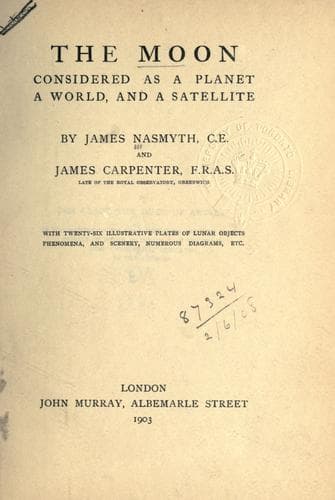
The Moon: considered as a planet, a world, and a satellite.Nasmyth, James
Science
The Moon: considered as a planet, a world, and a satellite.
Nasmyth, James
Moon
We find scarcely an instance of a small crater occurring just in the
centre of a large one, or taking the place of the cone. This is a
curious circumstance. Whenever we have any central feature in a great
crater, that feature is a cone. The tendency of this fact is to prove
that cones were produced by very weak efforts of this expiring force,
for had there been any strength in the last paroxysm it is presumable
that it would have blown out and left a crater. No very violent
eruptions have therefore taken place from the vents that were connected
with the great craters of the moon, nothing more powerful than could
produce a cone of exudation or a cinder-heap. And with regard to cones,
it is noteworthy that whether they be single or multiple, they never
rise so high as the circular ramparts of their respective craters. This
supports the inferred connexion between the crater origin and the cone
origin, for supposing the two to have been independent, a supposition
untenable in view of the universality of the central position of the
cone, it is scarcely conceivable that the mountains should have always
been located within ramparts higher than themselves. The less height
argues less power in the upcasting agency, and the diminished force may
well be considered as that which would almost of necessity precede the
expiration of the eruption.
Occasionally a crater is met with that has a double rampart, and the
concentricity suggests that there have been two eruptions from the same
vent: one powerful, which formed the exterior circle, and a second
rather less powerful which has formed the interior circle. It is not,
however evident that this duplication of the ring has always been due to
a double eruption. In many cases there is duplication of only a portion:
a terrace exhibits itself around a part of the circular range, sometimes
upon the outside and sometimes upon the inside. These terraces are not
likely to have been formed by any freak of the eruption, and we are led
to ascribe them in general to landslip phenomena. When, in the course of
a volcano’s formation, the piling-up of material about the vent has
continued till the lower portions have been unable to support the upper,
or when from any cause, the material composing the pile has lost its
cohesiveness, the natural consequence has been a breaking away of a
portion of the structure and its precipitation down the inclined sides
of the crater. Vast segments of many of the lunar mountain-rings appear
to have been thus dislodged from their original sites and cast down the
flanks to form crescent ranges of volcanic rocks either within or
without the circle. Nearly every one of our plates contains craters
exhibiting this feature in more or less extensive degree. Sometimes the
separated portion has been very small in proportion to the circumference
of the crater: Plato is an instance in which a comparatively small mass
has been detached. In other cases very large segments have slid down and
Public-domain text, read in full here on John Shaqi.
Reviews
Reviews
No reviews yet
Be the first to share your thoughts on this work.
Elsewhere in the archive
Join the Discussion
Join the discussion
Sign in to leave a comment or review.
Sign InorCreate an account