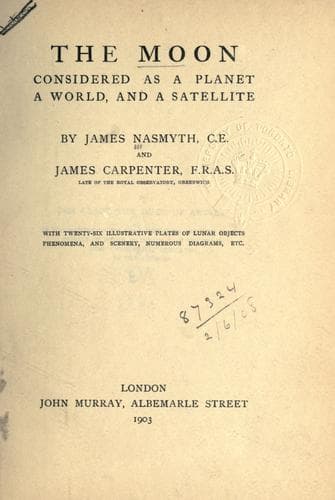
The Moon: considered as a planet, a world, and a satellite.Nasmyth, James
Science
The Moon: considered as a planet, a world, and a satellite.
Nasmyth, James
Moon
lie in segmental masses on the plateaux or form terraces around the
rampart. Aristarchus, Treisnecker and Copernicus exhibit this larger
extent of dislocation.
It is possible that these landslips occurred long after the formation of
the craters that have been subject to them. They are probably
attributable to recent disintegration of the lunar rocks, and we have a
powerful cause for this in the alternations of temperature to which the
lunar crust is exposed. We shall have occasion to revert to this subject
by-and-bye; at present it must suffice to point out that the extremes of
cold and heat, between which the lunar soil varies, are, with reasonable
probability, assumed to be on the one hand the temperature of space
(which is supposed to be about 200° below zero), and, on the other hand,
a degree of heat equal to about twice that of boiling water. A range of
at least 500° must work great changes in such heterogeneous materials as
we may conjecture those of the lunar crust to be, by the alternate
contractions and expansions which it must engender, and which must tend
to enlarge existing fissures and create new ones, to grind contiguous
surfaces and to dislodge unstable masses. This cause of change, it is to
be remarked, is one which is still exerting itself.
In a few cases we have an entirely opposite interruption of the
uniformity of a crater’s contour. Instead of the breaking away of the
ring in segments we see the entire circuit marked with deep ruts that
run down the flanks in a radial direction, giving us evidence of a
downward _streaming_ of semi-fluid matter, instead of a disruption of
solid masses. We cannot doubt that these ruts have been formed by lava
currents, and they indicate a condition of ejected material different
from that which existed in the cases where the landslip character is
found. In these last the ejecta appears to have been in the form of
masses of solidified or rapidly solidifying matter, which remained where
deposited for a time and then gave way from overloading or loss of
cohesiveness, whereas the substances thrown out in the case of the
rutted banks were probably mixed solid and fluid, the former remaining
upon the flanks while the latter trickled away. Nothing so well
represents, upon a small scale, this radial channelling as a heap of
wetted sand left for a while for the water to drain off from it. The
solid grains in such a heap sustain its general mass-form, but the
liquid in passing away cuts the surface into fissures running from the
summit to the base, and forms it into a model of a volcanic mountain
with every feature of peak, crag, and chasm reproduced, This similarity
of effect leads us to suspect a parallelism of cause, and thus to the
inference that the material which originally formed such a
crater-mountain as Aristillus (which is a most prominent example of this
rutted character, and appears in Plate IX., side by side with a crater
Public-domain text, read in full here on John Shaqi.
Reviews
Reviews
No reviews yet
Be the first to share your thoughts on this work.
Elsewhere in the archive
Join the Discussion
Join the discussion
Sign in to leave a comment or review.
Sign InorCreate an account