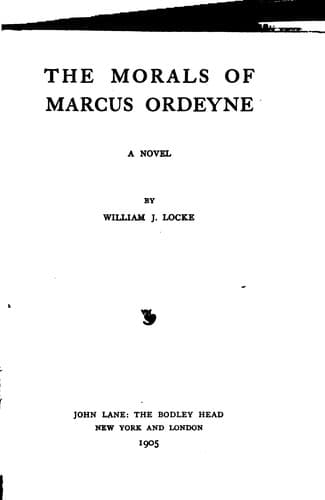
The Morals of Marcus Ordeyne : a NovelLocke, William John
Philosophy
The Morals of Marcus Ordeyne : a Novel
Locke, William John
Guardian and ward -- Fiction; Inheritance and succession -- Fiction; Scholars -- Fiction
I drove to St. John’s Wood Road, and learned to my dismay that Pasquale
had given up his rooms there a week ago. All his letters were addressed
to his club in Piccadilly. I drove thither. How has mankind contented
itself for these thousands of years with a horse as its chief means of
locomotion? Oh, the exasperation I suffered behind that magnified snail!
I dashed into the club. Mr. Pasquale had not been there all day. No, he
was not staying there. It was against the rules to give members’ private
addresses.
“But it’s a matter of life and death!” I cried.
“To tell you the truth, sir,” said the hall porter, “Mr. Pasquale’s only
permanent address is his banker’s, and we really don’t know where he is
staying at present.”
I wrote a hurried line:
“Hamdi has abducted Carlotta. I am half crazed. As you love me give me
your help. Oh, God! man, why aren’t you here?”
I left it with the porter, and crawled to Scotland Yard. The cabman at
my invectives against his sauntering beast waxed indignant; it was a
three-quarter blood mare and one of the fastest trotters in London.
“She passes everything,” said he.
“It is because everything is standing still or going backward or turned
upside down,” said I.
No doubt he thought me mad. Mad as a dingo dog. The thought of the
words, the summer and the sun sent a spasm of hunger through my heart.
Then I murmured to myself: “‘Save my soul from hell and my darling from
the power of the dog.’ Which dog? Not the dingo dog.” I verily believe
my brain worked wrong to-day.
Great Scotland Yard at last. I went through passages. I found myself in
a nondescript room where a courteous official seated at a desk held me
on the rack for half an hour. I had to describe Carlotta: not in the
imagery wherein only one could create an impression of her sweetness,
but in the objective terms of the police report. What was she wearing? A
hat, and jacket, a skirt, shoes; of course she wore gloves; possibly she
carried a muff. Impatient of such commonplace details, I described her
fully. But the glory of her bronze hair, her great dark brown eyes,
the quivering sensitiveness of her lips; her intoxicating compound of
Botticelli and the Venusberg; the dove-notes of her voice; all was a
matter of boredom to Scotland Yard. They clamoured for the colour of
her feathers and the material of which her dress was made; her height in
vulgar figures and the sizes of her gloves and shoes.
“How on earth can I tell you?” I cried in desperation.
“Perhaps one of your servants can give the necessary information,”
replied the urbane official. If I had lost an umbrella he could not have
viewed my plight with more inhuman blandness!
Public-domain text, read in full here on John Shaqi.
Reviews
Reviews
No reviews yet
Be the first to share your thoughts on this work.
Elsewhere in the archive
Join the Discussion
Join the discussion
Sign in to leave a comment or review.
Sign InorCreate an account