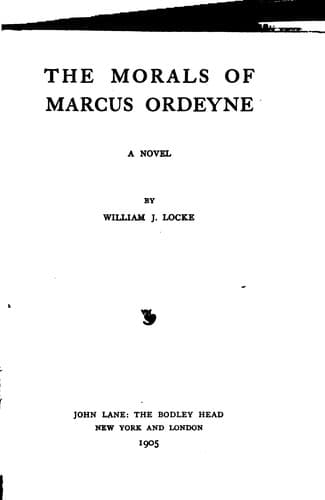
The Morals of Marcus Ordeyne : a NovelLocke, William John
Philosophy
The Morals of Marcus Ordeyne : a Novel
Locke, William John
Guardian and ward -- Fiction; Inheritance and succession -- Fiction; Scholars -- Fiction
A miracle happened. As I was writing a summons to Stenson to obtain
these details from Antoinette and attend at once, a policeman entered
and I learned that my confidential man was at the door. My heart
leapt within me. He had tracked me hither and had come to tell me that
Carlotta was safe. But the first glance at his face killed the wild
hope. He had tracked me hither, it is true; but only apologetically to
offer what information might be useful. “It is a very great liberty, Sir
Marcus, and I will retire at once if I have overstepped my duties, but
there are important details, sir, in catastrophes of this nature with
which my experience has taught me only servants can be acquainted.”
There must be a book of ten thousand pages entitled “The Perfect Valet,”
dealing with every contingency of domestic life which this admirable
fellow has by heart. He uttered his Ciceronian sentence with the gravity
of a pasteboard figure in the toy theatre of one’s childhood.
“Can you describe the young lady’s dress?” asked the official.
“I have made it my business,” said Stenson, “to obtain accurate
information as to every detail of Mademoiselle Carlotta’s attire when
she left the house this morning.”
I faded into insignificance. Stenson was a man after the Inspector’s
heart. A few eager questions brought the desired result. A dark red
toque with a grey bird’s wing; a wine-coloured zouave jacket and skirt,
black braided; a dark blue bodice; a plain gold brooch (the first
trinket I had given her--the occasion of her first clasp of arms around
my neck) fastening her collar; a silver fox necklet and muff; patent
leather shoes and brown suede gloves.
“Any special mark or characteristics?”
“A white scar above the left temple,” said Stenson.
Lord have mercy! The man has lived day by day for five months with
Carlotta’s magical beauty, and all he has noticed as characteristic is
the little white scar--she fell on marble steps as a child--the only
flaw, if flaw can be in a thing so imperceptible, in her perfect
loveliness.
“Mademoiselle has also a tiny mole behind her right ear,” said Stenson.
The Inspector’s conception of Stenson expanded into an apotheosis. He
paid him deference. His pen wrote greedily every syllable the inspired
creature uttered. When the fount of inspiration ran dry, Stenson turned
to me with his imperturbable, profoundly respectful air.
“Shall I return home, Sir Marcus, or have you any further need of my
service?”
I bade him go home. He withdrew. The Inspector smiled cheerfully.
“Now we can get along,” said he. “It’s a pity Mr.--Mr. Pasquale” (he
consulted his notes) “is out of touch with us for the moment. He might
have given us great assistance.”
He rose from his chair. “I think we shall very soon trace the
young lady. An accurate personal description like this, you see, is
invaluable.”
Public-domain text, read in full here on John Shaqi.
Reviews
Reviews
No reviews yet
Be the first to share your thoughts on this work.
Elsewhere in the archive
Join the Discussion
Join the discussion
Sign in to leave a comment or review.
Sign InorCreate an account