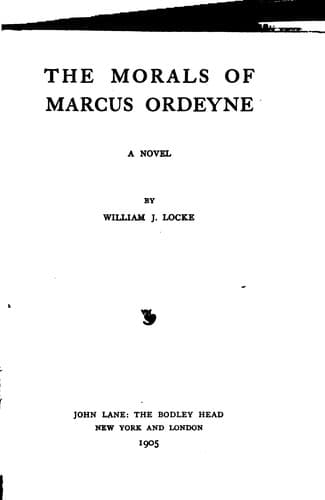
The Morals of Marcus Ordeyne : a NovelLocke, William John
Philosophy
The Morals of Marcus Ordeyne : a Novel
Locke, William John
Guardian and ward -- Fiction; Inheritance and succession -- Fiction; Scholars -- Fiction
“The general methods you adopt in the case of your congregation,” said
I, “are matters of perfect indifference to me. But I cannot see Judith
imprisoned for life in a tin church without a protest. Your proposal
reminds me of the Siennese who owed a victorious general more than they
could possibly repay. The legend goes that they hanged him, in order to
make him a saint after his death by way of reward. I object to this sort
of canonisation of Judith. And she will object, too. You seem to leave
her out of account altogether. She is mistress of her own actions. She
has a will of her own. She is not going to give up her comfortable flat
off the Tottenham Court Road in order to dwell in Hoxton. She won’t go
back to you under your conditions.”
He smiled indulgently and held out his hand to signify that the
interview was over.
“She will, Sir Marcus.”
Was there ever such a Torquemada of a creature? I respect religion. I
respect this man’s intense conviction of the reality of his conversion.
I can respect even the long frock coat and the long brown whiskers,
which in the case of so dashing a worldling as Rupert Mainwaring were
a deliberate and daily mortification of the flesh. But I hold in
shuddering detestation “the thumb-screw and the rack for the glory of
the Lord,” which he cheerfully contemplated applying to Judith.
“Why on earth can’t you let the poor woman alone?” I asked, ignoring his
hand.
“I am doing my duty to God and to her,” said he.
“With the result that you have driven her into hysterics.”
“She’ll get over them,” said he.
“I wish you good-day,” said I. “We might talk together for a thousand
years without understanding each other.”
“Pardon me,” he retorted, with the utmost urbanity. “I understand you
perfectly.”
He accompanied me to the dining-room where I had left my hat and
umbrella, and to the flat door which he politely opened. When it shut
behind me I felt inclined to batter it open again and to take Judith
by main force from under his nose. But I suppose I am pusillanimous. I
found myself in the street brandishing my umbrella like a flaming sword
and vowing to perform all sorts of Paladin exploits, which I knew in my
heart were futile.
I hailed an omnibus in the Tottenham Court Road, and clambered to the
top, though a slight drizzle was falling. Why I did it I have not
the remotest idea, for I abhor those locomotive engines of exquisite
discomfort. I had no preconceived notion of destination. It was a moving
thing that would carry me away from the Tottenham Court Road, away
from the Rev. Rupert Mainwaring, away from myself. I was the solitary
occupant of the omnibus roof. The rain fell, softly, persistently,
soakingly. I laughed aloud.
I recognised the predestined irony of things that at every corner checks
the course of the ineffectual man.
CHAPTER XX
November 11th.
Public-domain text, read in full here on John Shaqi.
Reviews
Reviews
No reviews yet
Be the first to share your thoughts on this work.
Elsewhere in the archive
Join the Discussion
Join the discussion
Sign in to leave a comment or review.
Sign InorCreate an account