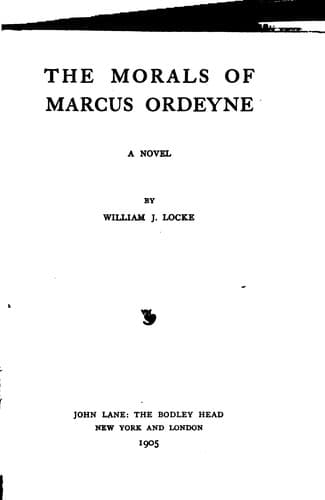
The Morals of Marcus Ordeyne : a NovelLocke, William John
Philosophy
The Morals of Marcus Ordeyne : a Novel
Locke, William John
Guardian and ward -- Fiction; Inheritance and succession -- Fiction; Scholars -- Fiction
I wrote Judith a long letter last night, urging her to disregard the
forfeited claims of her husband and to join her life definitely with
mine. I was cynical enough to feel that if such a proceeding annoyed
the Rev. Rupert Mainwaring it would serve him right. The fact of a man’s
finding religion and abjuring sack does not in itself exculpate him from
wrongs which he has inflicted on his fellow-creatures in unregenerate
days. Mainwaring deserved some punishment of which he seemed to have had
remarkably little; for, mind you, his sack-cloth and ashes at Hoxton,
although sincerely worn, are not much of a punishment to a man in his
exalted mood. Now, on the contrary, Judith deserved compensation, such
as I alone was prepared to offer her in spite of conventional morality
and the feelings of the Rev. Rupert Mainwaring. Indeed, it seemed to
be the only way of saving Judith from being worried out of her life by
frantic appeals to embrace both himself and Primitive Christianity.
Her position was that of Andromeda. Mine that of an unheroic Perseus,
destined to deliver her from the monster--the monster whose lair is a
little tin mission church in Hoxton.
I wrote the letter in one of those periods of semi-vitality when the
pulses of emotion throb weakly, and sensitiveness is dulled. To-day
I have felt differently. My nerves have been restrung. Something
ironically vulgar, sordidly tragic has seemed to creep into my relations
with Judith.
To my great surprise Judith brought her answer in person this evening.
It is the first time she has entered my house; and her first words, as
she looked all around her with a wistful smile referred to the fact.
“It is almost just as I have pictured it--and I have pictured it--do you
know how often?”
She was calmer, if not happier. The haggard expression had given place
to one of resignation. I wheeled an arm-chair close to the fire, for she
was cold, and she sank into it with a sigh of weariness. I knelt beside
her. She drew off her gloves and put one hand on my head in the old way.
The touch brought me great comfort. I thought that we had reached the
quiet haven at last.
“So you have come to me, Judith,” I whispered.
“I have come, dear,” she said, “to tell you that I can’t come.”
My heart sank.
“Why?” I asked.
We fenced a little. She gave half reasons, womanlike, of which I proved
the inadequacy. I recapitulated the arguments I had used in my letter.
She met them with hints and vague allusions. At last she cut the knot.
“I am going back to my husband.”
I rose to my feet and echud the words. She repeated them in a tone so
mournfully distinct, that they had the finality of a death-knell. I had
nothing to say.
“Before we part I must make my peace with you, Marcus,” she said. “I
have suddenly developed a conscience. I always had the germs of it.”
“You were always the best and dearest woman in the world,” I cried.
Public-domain text, read in full here on John Shaqi.
Reviews
Reviews
No reviews yet
Be the first to share your thoughts on this work.
Elsewhere in the archive
Join the Discussion
Join the discussion
Sign in to leave a comment or review.
Sign InorCreate an account