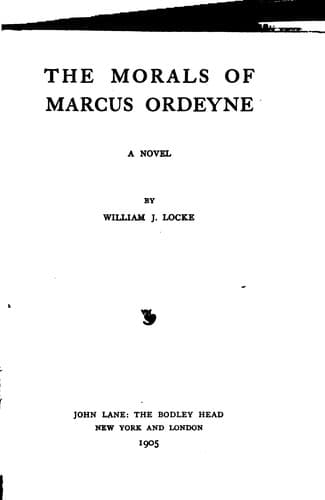
The Morals of Marcus Ordeyne : a NovelLocke, William John
Philosophy
The Morals of Marcus Ordeyne : a Novel
Locke, William John
Guardian and ward -- Fiction; Inheritance and succession -- Fiction; Scholars -- Fiction
I would sooner talk to Antoinette than the tutorial staff of Girton. If
she woke up one morning and found she had a mind she would think it a
disease.
In the afternoon I strolled into Regent’s Park and meeting the
McMurray’s nine-year-old son in charge of the housemaid, around whom
seemed to be hovering a sheepish individual in a bowler hat, I took him
off to the Zoological Gardens. On the way he told me, with great glee,
that his German governess was in bed with an awful sore throat; that he
wasn’t doing any lessons; that the sheepish hoverer was Milly’s young
man, and that the silly way they went on was enough to make one sick.
When he had fed everything feedable and ridden everything ridable, I
drove him to the Wellington Road and deposited him with his parents. I
love a couple of hours with a child when it is thoroughly happy and
on its best behaviour. And the enjoyment is enhanced by the feeling of
utter thankfulness that he is not my child, but somebody else’s.
In the evening I read and meditated on the happiness of my lot.
The years of school drudgery have already lost their sharp edge of
remembered definition, and sometimes I wonder whether it is I who lived
through them. I had not a care in the world, not a want that I could not
gratify. I thought of Judith. I thought of Sebastian Pasquale. I
amused myself by seeking a Renaissance type of which he must be the
reincarnation. I fixed upon young Olgiati, one of the assassins of
Gian Galeazzo Sforza. Of the many hundreds of British youths who passed
before my eyes during my slavery, he is the only one who has sought
me out in his manhood. And strange to say we had only a few months
together, during my first year’s apprenticeship to the dismal craft, he
being in the sixth form, and but three or four years younger than I. He
was the maddest, oddest, most diabolical and most unpopular boy in the
school. The staff, to whom the conventional must of necessity be always
the Divine, loathed him. I alone took to the creature. I think now that
my quaint passion for the cinquecento Italian must have had something
to do with my attraction. In externals he is as English as I am, having
been brought up in England by an English mother, but there are thousands
of Hindoos who are more British than he. The McMurrays were telling me
dreadful stories about him this afternoon. Sighing after an obdurate
Viennese dancer, he had lured her coachman into helpless intoxication,
had invested himself in the domestic’s livery, and had driven off with
the lady in the darkness after the performance to the outskirts of the
town. What happened exactly, the McMurrays did not know; but there was
the devil to pay in Vienna. And yet this inconsequent libertine did the
following before my own eyes. We were walking down Piccadilly together
one afternoon in the hard winter of 1894. It was a black frost,
agonizingly cold. A shivering wretch held out matches for sale. His
hideous red toes protruded through his boots.
Public-domain text, read in full here on John Shaqi.
Reviews
Reviews
No reviews yet
Be the first to share your thoughts on this work.
Join the Discussion
Join the discussion
Sign in to leave a comment or review.
Sign InorCreate an account