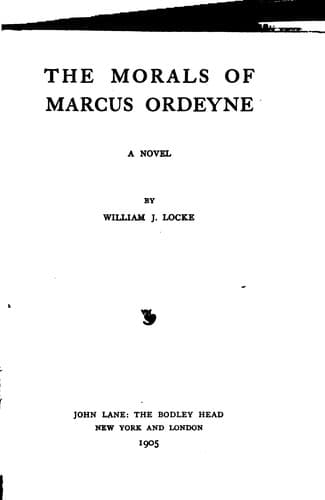
The Morals of Marcus Ordeyne : a NovelLocke, William John
Philosophy
The Morals of Marcus Ordeyne : a Novel
Locke, William John
Guardian and ward -- Fiction; Inheritance and succession -- Fiction; Scholars -- Fiction
Filled with peace and good-will to all men, like a personification
of Christmas in May, I started out this morning to see my lawyers. I
reached them at three o’clock, having idled at second-hand bookstalls
and lunched on the road. I signed their unintelligible document, and
wandered through the Temple Gardens and along the Embankment. When I had
passed under Hungerford Bridge, it struck me that I was warm, a little
leg-weary, and the Victoria Embankment Gardens smiled an invitation
to repose. I struck the shady path beneath the terrace of the National
Liberal Club, and sat myself down on a comfortable bench. The only other
occupant was a female in black. As I take no interest in females
in black, I disregarded her presence, and gave myself up to the
contemplation, of the trim lawns and flower-beds, the green trees
masking the unsightly Surrey side of the river, and the back of the
statue of Sir Bartle Frere. A continued survey of the last not making
for edification (a statue that turns its back on you being one of
the dullest objects made by man), I took from my pocket a brown
leather-covered volume which I had fished out of a penny box: “_Suite de
l’Histoire du Gouvernement de Venise ou L’Histoire des Uscoques, par le
Sieur Houssaie, Amsterdam, MDCCV._” A whole complete scholarly history
of a forgotten people for a penny. The Uscoques were originally
Dalmatians who settled at Segna on the Adriatic and became the most
pestiferous colony of pirates and desperadoes of sixteenth century
Europe. I opened the yellow-stained pages and savoured their acrid musty
smell. How much learning, thought I, bought with the heart’s-blood, how
many million hours of fierce intellectual struggle appeal to mankind
nowadays but as an odour, an odour of decay, in the nostrils of here and
there a casual student. I thought this, and my eye caught, repeated many
times, the name of the Frangipani, once lords of Segna. As men, their
achievements are wiped out of commonly remembered history; but their
name is distilled into a sensuous perfume which perchance may be found
in the penny scent fountains of to-day. I was smiling over this quaint
olfactory coincidence, and wondering whether any human being alive at
that moment had ever read the Sieur Houssaie’s book, when a tug at my
arm, such as a neglected terrier gives with his paw, brought me back to
the workaday world. I turned sharply and met a pair of melting, brown,
piteous, imploring dog’s eyes, belonging not to a terrier, but to the
disregarded female in black.
“Will you please, sir, to tell me what I must do.”
Public-domain text, read in full here on John Shaqi.
Reviews
Reviews
No reviews yet
Be the first to share your thoughts on this work.
Join the Discussion
Join the discussion
Sign in to leave a comment or review.
Sign InorCreate an account