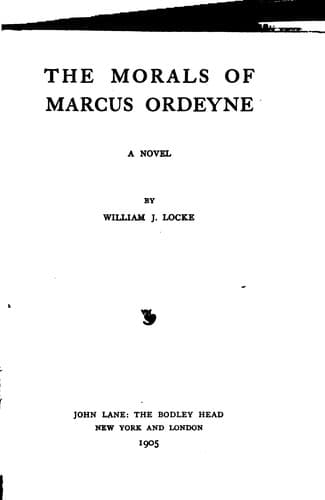
The Morals of Marcus Ordeyne : a NovelLocke, William John
Philosophy
The Morals of Marcus Ordeyne : a Novel
Locke, William John
Guardian and ward -- Fiction; Inheritance and succession -- Fiction; Scholars -- Fiction
I told her to give me time. One is not in the habit of meeting abducted
Lights of the Harem in the Embankment Gardens, beneath the National
Liberal Club. It was, in fact, a bewildering occurrence. I looked around
me. Nothing seemed to have happened during the last ten minutes. A pale
young man on the next bench, whom I had noticed when I entered, was
reading a dirty pink newspaper. Pigeons and sparrows hopped about
unconcernedly. On the file of cabs, just perceptible through the
foliage, the cabmen lolled in listless attitudes. Sir Bartle Frere
stolidly kept his back to me, not the least interested in this Gilbert
a Becket story. I always thought something was wrong with that man’s
character.
What on earth could I tell her to do? The best course was to find the
infernal Harry. I asked her how she came to lose him. It appears he
escorted her ashore at Southampton, after having scarcely set eyes
on her during the voyage, put her into a railway carriage with strict
injunctions not to stir until he claimed her, and then disappeared into
space.
“Did he give you your ticket?”
“No.”
“What a young blackguard!” I exclaimed.
“I don’t like him at all,” she said.
How she managed to elude the ticket collector at Vauxhall I could not
exactly discover. Apparently she told him, in her confiding manner, that
Harry had it, and when he found no Harry in the train and came back to
say so, she turned her dewy imploring eyes on him and the sentimental
varlet melted. At Waterloo a man had told her she must get out of the
carriage--she had travelled alone in it--and she had meekly obeyed. She
had wandered out of the station and across a bridge and had eventually
found herself in the Embankment Gardens. Then she had asked me how to
find Harry. Really she was ridiculously like Thomas a Becket’s Saracen
mother crying in London for Gilbert. And the most ludicrous part of the
resemblance was that she did not know the creature’s surname.
“By the way,” said I, “what is your name?”
“Carlotta.”
“Carlotta what?” I asked.
“I have no other name.”
“Your father--the Vice-Consul--had one.”
She wrinkled her young forehead in profound mental effort.
“Ramsbotham,” she said at last, triumphantly.
“Now look here, Miss Ramsbotham--no,” I broke off. “Such an appellation
is anachronistic, incongruous, and infinitely absurd. I can’t use it. I
must take the liberty of addressing you as Carlotta.”
“But I’ve told you that Carlotta is my name,” she said, in
uncomprehending innocence.
“And mine is Sir Marcus Ordeyne. People call me ‘Sir Marcus.’”
“Seer Marcous,” said Carlotta.
She did not seem at all impressed with the fact that she was talking to
a member of the baronetage.
Public-domain text, read in full here on John Shaqi.
Reviews
Reviews
No reviews yet
Be the first to share your thoughts on this work.
Join the Discussion
Join the discussion
Sign in to leave a comment or review.
Sign InorCreate an account