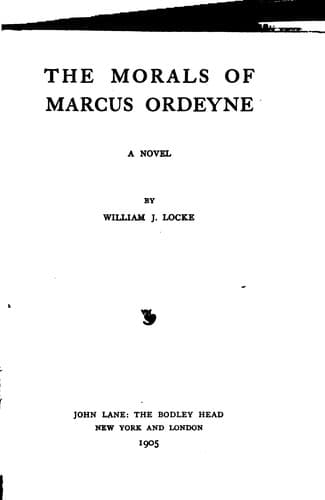
The Morals of Marcus Ordeyne : a NovelLocke, William John
Philosophy
The Morals of Marcus Ordeyne : a Novel
Locke, William John
Guardian and ward -- Fiction; Inheritance and succession -- Fiction; Scholars -- Fiction
To-day I have had a curious interview. Who should call on me but the
father of the hapless Harry Robinson. My first question was a natural
one. How on earth did he connect me with the death of his son? How did
he contrive to identify me as the befriender of the young Turkish girl
whose interests, he declared, were the object of his visit? It appeared
that the police had given him the necessary information, my adventures
at Waterloo having rendered their tracing of Carlotta an easy matter.
I had been wondering somewhat at the meagre newspaper reports of the
inquest. No mention was made, as I had nervously anticipated, of
the mysterious lady for whom the deceased had bought a ticket at
Alexandretta, and with whom he had come ashore. Very little evidence
appeared to have been taken, and the jury contented themselves with
giving the usual verdict of temporary insanity. I touched on this as
delicately as I could. “We succeeded in hushing things up,” said my
visitor, an old man with iron-grey whiskers and a careworn sensitive
face. “I have some influence myself, and his wife’s relations--”
“His wife!” I ejaculated. The ways of men are further than ever from
interpretation. The fellow was actually married!
“Yes,” he sighed. “That is what would have made such a terrible scandal.
Her relatives are powerful people. We averted it, thank Heaven, and his
poor wife will never know. My boy is dead. No public investigation into
motives would bring him back to life again.”
I murmured words of condolence.
“He must have been out of his mind, poor lad, when he induced the girl
to run away with him. But, as my son has ruined her,” he set his teeth
as if the boy’s sin stabbed him, “I must look after her welfare.”
“You may set your mind at rest on that point,” said I. “He smuggled her
at once aboard the ship, and seems scarcely to have said how d’ye do to
her afterwards. That is the mad part of it.”
“Can I be sure?”
“I would stake my life on it,” said I.
“How do you know?”
“Frankness--I may say embarrassing frankness is one of the young lady’s
drawbacks.”
He looked greatly relieved. I acquainted him with Carlotta’s
antecedents, and outlined the part I had played in the story.
“Then,” said he, “I will see the child back to her home. I will take
her there myself. I cannot allow you any longer to have the burden of
befriending her, when it is my duty to repair my boy’s wrongdoing.”
I explained to him the terror of Hamdi Effendi’s clutches, and told him
of my promise.
“Then what is to be done?” he asked.
“If any kind people could be found to receive her into their family, and
bring her up like a Christian, I should hand her over with the greatest
of pleasure. If there is one thing I do not require in this house, it is
an idle and irresponsible female. But philanthropists are rare. Who will
take her?”
“I’m afraid I’m not prepared to do that.”
Public-domain text, read in full here on John Shaqi.
Reviews
Reviews
No reviews yet
Be the first to share your thoughts on this work.
Join the Discussion
Join the discussion
Sign in to leave a comment or review.
Sign InorCreate an account