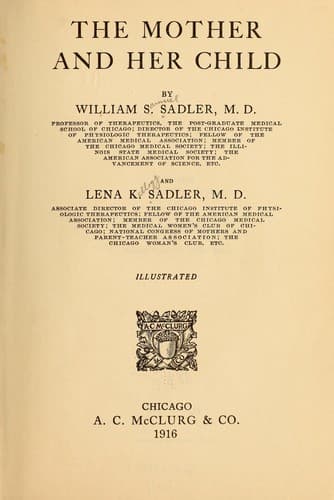
The Mother and Her ChildSadler, William S. (William Samuel)
Science
The Mother and Her Child
Sadler, William S. (William Samuel)
Child care; Infants -- Care; Infants -- Health and hygiene; Pregnancy
A friend of ours who presides over a court of domestic relations in a
large city, recently told us that he believed much trouble was caused
in families--many divorces, occasioned, and many desertions
provoked--because improperly fed babies were cross and irritable and
so completely occupied the time of the mother, who, herself, knew
nothing about mothercraft or the art of infant feeding. Consequently,
the home was neglected and unhappy, quarreling abounded and failure,
utter failure, resulted. The children were constantly cross, and so
much of the mother's time was consumed in caring for these irritable,
half-fed babies, that the home was disheveled, the meals never ready,
the husband's home-coming was a dreaded occurrence, and he,
endeavoring to seek rest and relaxation, usually sought for it in the
poolroom or the saloon, with the usual climax which never fails to
bring the time-honored results of debauch--despair and desertion.
In the beginning of this book we paid our respects to the present-day
educational system which does not provide an adequate compulsory
course in which all women could be given at least a working knowledge
of home making and the care and feeding of the babies; so that
statement need not be repeated in this chapter. But we wish to add, in
passing, that ignorance is the basis and the foundation of more
unhappy homes, broken promises, panicky divorces, and shattered hopes,
as well as of more deaths during the first year of infancy, than any
other cause. And in speaking of its relationship to babycraft, we
believe that ignorance concerning normal stools, how many times a day
the bowels should move; how much a baby's stomach holds; how often he
should be fed, etc.--I say it is ignorance of these essential details
that lies at the bottom of many problems which come up during the
first year, particularly the "feeding problem."
INFANT WELFARE
In the city of Chicago at the time of this writing, the Infant Welfare
Association maintains over twenty separate stations where meetings are
held for mothers, where lectures are delivered on the care and feeding
of babies. Babies are brought to these stations week in and week out;
they are weighed and measured and, if bottle-fed, nurses are sent to
the homes to teach the mother how properly to modify the milk in
accordance with the physician's orders. The health authorities of our
city also maintain several such stations where mothers and babies may
have this efficient help. A corps of nurses are employed to carry out
the instructions and to follow up the mothers and the babies in their
homes, and thus the death rate has been greatly reduced, not only in
our city but in all such cities where baby stations have been
instituted. In a certain ward in Philadelphia the death rate was
reduced forty-four per cent in one year after the baby stations were
established.
CHOOSING A FORMULA
Public-domain text, read in full here on John Shaqi.
Reviews
Reviews
No reviews yet
Be the first to share your thoughts on this work.
Elsewhere in the archive
Join the Discussion
Join the discussion
Sign in to leave a comment or review.
Sign InorCreate an account