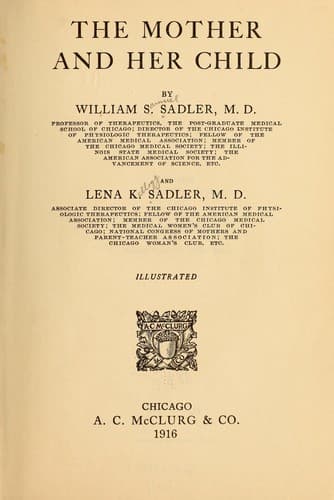
The Mother and Her ChildSadler, William S. (William Samuel)
Science
The Mother and Her Child
Sadler, William S. (William Samuel)
Child care; Infants -- Care; Infants -- Health and hygiene; Pregnancy
There are three classes of infants who require weak-milk mixtures to
begin with: namely, the baby who has been previously nursed and whose
mother's milk has utterly failed; the baby just weaned; and the infant
whose power to digest is low. If these children were six months old,
and the formula best suited to them is unknown, we must begin with a
formula suited to a two- or three-month-old child and quickly work up
to the six-month formula, which may often be accomplished within two
or three days.
THE BOTTLE-FED BABY
When a baby is getting on well with his food, he should show the
following characteristics: He should have a good appetite; should have
no vomiting or gas; he should cry but little; and he should sleep
quietly and restfully. His bowels should move once or twice in
twenty-four hours. His stool should be a pasty homogeneous mass. He
should possess a clear skin and good color. He should show some gain
each week--from four to eight ounces--and he should also show mental
development.
As long as a baby appears happy and gains from four to eight ounces a
week and seems comfortable and well satisfied, the feeding mixture
should not be changed or increased.
MAKE CHANGES GRADUALLY
In our experience with the artificial feeding of infants, we have come
to look upon the practice of gradually changing the food formula as
the most important element in successful baby feeding.
We recall one mother in the suburbs who came to us with her baby who
had been feeding on a certain proprietary food. She declared that it
"just couldn't take cow's milk." She admitted "it was not doing well,"
and so she would like to have help. The baby was old enough, had it
been normal, to have been taking whole milk for some time. We recall
our having the mother prepare the proprietary food just as she had
been used to preparing it, and each day we had her throw away one-half
ounce and put in one-half ounce of whole milk, this mixture she fed
the baby for two days.
The next time, we had her take out one ounce of the mixture and put in
one ounce of whole milk, which we fed the baby for three successive
days; and then one and one-half ounces were substituted which was fed
to the baby for four days; and thus we carefully, slowly, and
gradually withdrew the proprietary food and substituted fresh,
certified cow's milk. It took us a month to complete the change, but
we are glad to add that it was done without in the least disturbing
the child.
Now, had the change been made abruptly--in a day or two, or three
days--the baby would probably have been completely upset, while both
the mother and the doctor would have been greatly discouraged. Many
mothers and even some physicians have jumped from one baby food to
another baby food; they have tried this and they have tried that,
until the poor child, having been the victim of a number of such
dietetic experiments, finally succumbed.
Public-domain text, read in full here on John Shaqi.
Reviews
Reviews
No reviews yet
Be the first to share your thoughts on this work.
Elsewhere in the archive
Join the Discussion
Join the discussion
Sign in to leave a comment or review.
Sign InorCreate an account