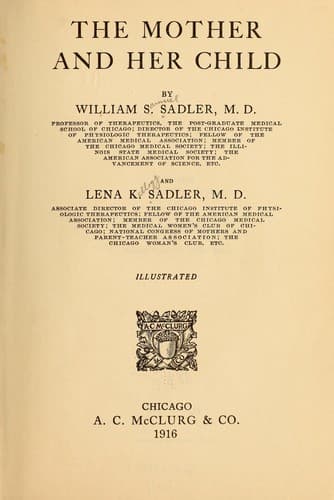
The Mother and Her ChildSadler, William S. (William Samuel)
Science
The Mother and Her Child
Sadler, William S. (William Samuel)
Child care; Infants -- Care; Infants -- Health and hygiene; Pregnancy
We cannot urge too strongly the fact that, as a rule, whenever a
change is made from one food to another, it should be done gradually,
unless it be the change of a single element such as that of a very
high per cent of cream found in top milk mixtures, when it seems to be
a troublesome element in the milk. No bad effects will follow the
quick change to skimmed milk with added sugar, starches, etc; but in
changing from a proprietary food to a milk mixture, the change should
always be made gradually, the quantity of the new food being increased
gradually. Milk should be increased by quarter (1/4) ounce additions,
and it should not be increased more than one ounce in one week; while
the mixture should not be increased as long as the baby is gaining
satisfactorily. A wise mother and an experienced physician can usually
see at a glance when a child is doing well--by the color and
consistency of the stools, the child's appetite, his sleep, and his
general disposition.
COMMON MISTAKES IN FORMULAS
First and foremost, we believe a great mistake is often made in using
too heavy cream mixtures; babies as a rule do not stand the use of too
high a percentage of cream. Formulas that call for whole milk should
contain four per cent fat or cream; and while babies often gain
rapidly on the higher percentage of cream found in a rich Jersey milk,
nevertheless, sooner or later serious disturbances of digestion
usually occur. Herd milk is, therefore, better for the babies because
in the "whole milk" of the herd of Holsteins we have only about four
per cent fat.
Another common mistake is too heavy feeding at the time of an attack
of indigestion; even the usual feeding may be too heavy during this
time of indisposition. It is not at all uncommon for us to dilute
baby's food to one-third its strength at the time of an acute illness.
Still another trouble maker is dirt--dirt on the dish-towel, dirt on
the nipple, dirt in the milk, dirt on the mother's hands. Dirt is an
ever present evil and an endless trouble maker, as evidenced by stool
disturbances, indigestion, fretful days, and sleepless nights. A dirty
refrigerator is another factor which has been responsible for much
illness and distress.
Indigestion is often brought on because a nurse, caretaker, or
possibly the mother, not wishing to go down to the refrigerator in the
middle of the night, brings up the food early in the evening and
allows it to become warm--to remain in a thermos bottle--and we are
sure that had they been able to see the enormous multiplication of
germs because of this warm temperature, they would never have given
occasion for such an increase in bacteria just to save themselves a
trifle of inconvenience.
Public-domain text, read in full here on John Shaqi.
Reviews
Reviews
No reviews yet
Be the first to share your thoughts on this work.
Elsewhere in the archive
Join the Discussion
Join the discussion
Sign in to leave a comment or review.
Sign InorCreate an account