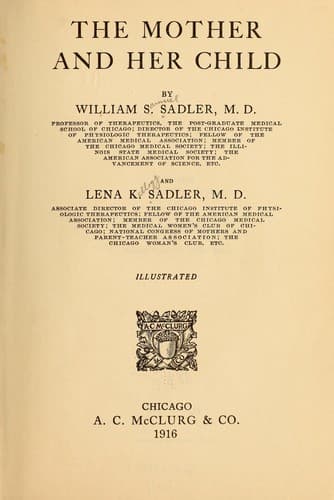
The Mother and Her ChildSadler, William S. (William Samuel)
Science
The Mother and Her Child
Sadler, William S. (William Samuel)
Child care; Infants -- Care; Infants -- Health and hygiene; Pregnancy
The baby should begin to talk at one year. He early learns to say
"mamma" and "papa," and gradually adds nouns to his vocabulary, so
that at eighteen months the normal child should have a vocabulary of
one hundred to one hundred and fifty words. As he nears the two-year
mark, he has acquired a few simple verbs and he can possibly put three
words together, such as, "Willie wants drink." Pronouns come in late,
as we all recall that the young child usually speaks of himself by his
own name.
Children are born mimics. If you talk baby talk to them, they will
talk baby talk back. For instance, a well known author told us just
the other day that for many years no other name was given to the
sewing machine in his house but the word "mafinge," and not until he
went to school did he correct the word "bewhind," for in the nursery
he learned the line "wagging their tails bewhind them." Baby talk is
very cunning, and often the adult members of the family pick it up and
keep it up for years, and only when they are exposed in public, as one
mother was on a suburban platform by her four-year-old lad shouting,
"Mamma, too-too tain tumin, too-too tain tumin," do they sense their
responsibility and realize how difficult it is to form new habits.
This poor mother tried in vain to have her little fellow say, as did
another little lad two and one-half years old, "Mother, the train's
coming; let's get on."
Many words of our beloved language at best are hard to understand; so
let us speak correct English to the little folks and they will reward
us by speaking good English in return.
If at two years the child makes no attempt at speech, suspicions
should be aroused concerning mutism or other serious nervous defects.
Medical advice should be sought.
DEFECTIVE SPEECH
All guttural tones which may be occasioned by adenoids or enlarged
tonsils, all lisping, stuttering, or defective speech of all words
should be taken in hand at the very start, as they are usually
overcome by constant repetition of the correct manner of speaking the
particular word in question. Children of defective speech need special
training, and should in no way be allowed rapidly to repeat little
nursery rhymes, as oftentimes this rapid repetition of rhymes by a
child with hereditary nervous defects may occasion stuttering or
stammering later on.
CALISTHENICS
Public-domain text, read in full here on John Shaqi.
Reviews
Reviews
No reviews yet
Be the first to share your thoughts on this work.
Elsewhere in the archive
Join the Discussion
Join the discussion
Sign in to leave a comment or review.
Sign InorCreate an account