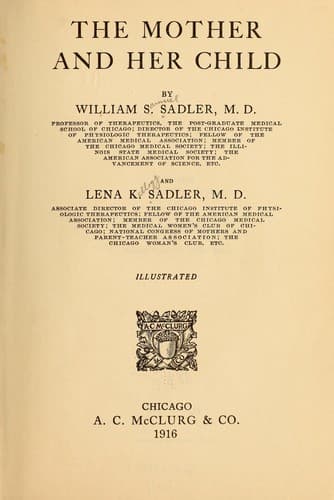
The Mother and Her ChildSadler, William S. (William Samuel)
Science
The Mother and Her Child
Sadler, William S. (William Samuel)
Child care; Infants -- Care; Infants -- Health and hygiene; Pregnancy
Special exercise should not be forced upon young children. Physical
culture, along with many other things intended for sedentary adults,
should never be forced upon little folks who get all of the exercise
they need in the many journeys they take building their blocks,
sailing their boats, tearing down imaginary houses, making imaginary
journeys--from morning until night the little feet are kept
busy--never stopping until the sandman comes at sleepy time. Do not
yourself attempt to stimulate a child who seems backward. Consult your
physician. You had much better put a child out to grow up in the yard
by himself with his sandpile than to force calisthenics or advance
physical training upon him.
BOW LEGS AND WALKING
Do not attempt to hasten nature in aiding the child to walk. Let him
creep, roll, slide, or even hunch along the floor--wait until he pulls
himself to his feet and gradually acquires the art of standing alone.
If he is overpersuaded to take "those cute little steps" it may result
in bow legs, and then--pity on him when he grows up. Sometimes flat
foot is the result of early urging the child to rest the weight of the
body upon the undeveloped arch. A defect in the gait or a pigeon toe
is hard to bear later on in life. A certain amount of pigeon-toeing is
natural and normal. If the baby is heavy he will not attempt to walk
at twelve months. He will very likely wait until fourteen or fifteen
months. The lighter-weight children sometimes walk as early as eleven
months, but they should all be walking at eighteen months, and if not,
it is usually indicative of backward mentality.
If the training of the bowels and bladder will replace the diapers
with drawers, the baby will attempt to walk sooner than when
encumbered with a bunglesome bunch of diaper between the thighs. The
little fellow runs alone at sixteen months and thoroughly enjoys it,
and the wise mother will pay no attention to the small bumps which are
going to come plentifully at this particular time.
SUMMARY OF BABY'S DEVELOPMENT
He discovers his hands at three or four months. At six months he sits
alone, plays with simple objects, grasps for objects, and laughs aloud
from the third to the fifth month. He says "goo goo" at four or five
months. At one year he should stand with support, listen to a watch
tick, follow moving objects, know his mother, play little games, such
as rolling a ball, should have trebled his birth weight, and have at
least six teeth, and should use three words in short sentences. At
eighteen months he should say "mamma" spontaneously, walk and run
without support, should have quite a vocabulary, should be able to
perform small errands like "pick up the book," and should have twelve
to sixteen teeth. At two years he should be interested in pictures,
able to talk intelligently, and know where his eyes, nose, mouth,
hands, and feet are. At three years, he should enumerate the objects
in a picture, tell his surname, and repeat a sentence with six words.
Public-domain text, read in full here on John Shaqi.
Reviews
Reviews
No reviews yet
Be the first to share your thoughts on this work.
Elsewhere in the archive
Join the Discussion
Join the discussion
Sign in to leave a comment or review.
Sign InorCreate an account