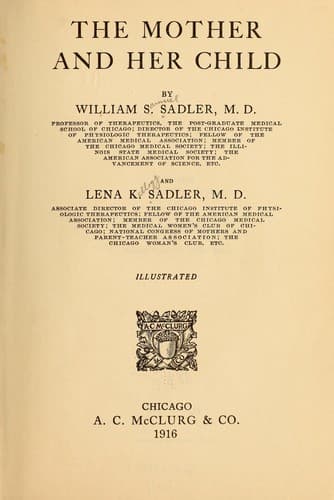
The Mother and Her ChildSadler, William S. (William Samuel)
Science
The Mother and Her Child
Sadler, William S. (William Samuel)
Child care; Infants -- Care; Infants -- Health and hygiene; Pregnancy
Let the children's diet be simply planned, well cooked, thoroughly
masticated, and above all things have regular meal hours, and no
"piecing" between meals; and if the mother begins thus early with her
little fellow, she will be rewarded some later day by hearing him say
to some well-meaning neighbor, who has just given him a delicious
cookie or a bit of candy: "Thank you, I will keep it until meal time."
Children learn one of the greatest lessons of self control in
following the teaching that nothing should pass the lips between meals
but water or a fruit-ade. Children in the second year require four
meals a day, one of which is usually only the bottle or a cup of milk.
These meals are usually taken at six, ten, two, and six in the
evening. Oftentimes this early six o'clock meal is just a bottle or
cup of milk, as may also be the evening meal.
CANDY
Now, a word about candy. Pure candy is wholesome and nourishing. It is
high in calorific value, and children should be allowed to have it if
it does not enter the stomach in solutions stronger than ten or
fifteen per cent. We can see at a glance that chocolate creams,
bonbons, and other soft candies should never be given to children.
Candies that they can suck, such as fruit tablets, stick candy,
sunshine candy, and other hard confections that are pure, and free
from mineral colorings and other concoctions such as are commonly used
in the cheaper candies, may safely be given at the close of the
meals--but never between meals.
All such articles as tea, coffee, beer, soft candies, condiments,
pastries, and fried foods, should be positively avoided in the case of
all children under five and six years of age.
The diet from now on will be considered in the chapter "Diet and
Nutrition."
PART III
THE CHILD
PART III
THE CHILD
CHAPTER XXV
THE SICK CHILD
To the mother who has passed through the experience of bringing the
child into the world is usually given that intuitiveness which helps
her in caring for that child when it is well and in recognizing
certain symptoms when it is sick. The newborn baby brings with him a
large responsibility, but as the weeks pass by his care becomes less
and less of a nervous strain, as the routine duties, so nearly alike
each day of his little life, have made the task comparatively easy;
but when the baby gets sick, particularly if he is under one year of
age, and it is impossible for him clearly to make known his wants, and
being unable to tell where it hurts or how badly it hurts, the average
mother is likely to become somewhat panicky; and this confusion of
mind often renders her quite unfit successfully to nurse the sick
baby.
THE NURSE
Public-domain text, read in full here on John Shaqi.
Reviews
Reviews
No reviews yet
Be the first to share your thoughts on this work.
Elsewhere in the archive
Join the Discussion
Join the discussion
Sign in to leave a comment or review.
Sign InorCreate an account