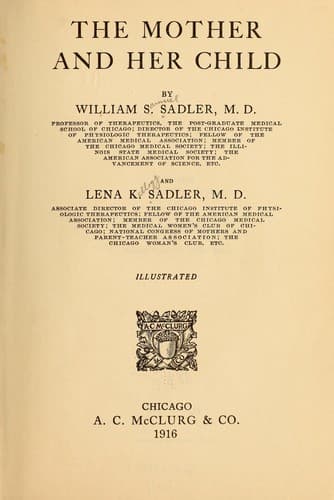
The Mother and Her ChildSadler, William S. (William Samuel)
Science
The Mother and Her Child
Sadler, William S. (William Samuel)
Child care; Infants -- Care; Infants -- Health and hygiene; Pregnancy
The expression of the face varies with the disease. In whooping
cough and measles the face is swollen and somewhat flushed,
giving the child a heavy, stupid expression. There is also
swelling of the face, especially about the eyes, in Bright's
disease. Repeated momentary crossing of the eyes often indicates
approaching convulsions. In very severe acute diarrhea it is
astonishing with what rapidity the face will become sunken and
shriveled, and so covered with deep lines that the baby is almost
unrecognizable. The same thing occurs more slowly in the
condition commonly known as marasmus. Often the face has an
expression of distress in the beginning of any serious disease.
If the edges of the nostrils move in and out with breathing, we
may suspect some difficulty of respiration, such as attends
pneumonia. The baby sleeps with its eyes half open in exhausted
conditions or when suffering pain.
THE HEAD
The head exhibits certain noteworthy features. Excessive
perspiration when sleeping is an early symptom of rickets. It
must be remembered, however, that any debilitated child may
perspire more or less when asleep. Both in rickets and in
hydrocephalus (water on the brain) the face seems small and the
head large, but in the former the head is square and flat on top,
while in the latter it is of a somewhat globular shape. The
fontanelle is prominent and throbs forcibly in inflammation of
the brain, is too large in rickets and hydrocephalus, bulges in
the latter affection, and sometimes sinks in conditions with only
slight debility.
THE CHEST
The chest exhibits a heaving movement with a drawing in of the
spaces between the ribs in any disease in which breathing is
difficult. A chicken-breasted chest is seen in Pott's disease of
the spine, and to some extent in bad cases of enlargement of the
tonsillar tissue; a "violin-shaped" chest in rickets; a bulging
of one side in pleurisy with fluid; and a long, narrow chest,
with a general flattening of the upper part, in older children
predisposed to consumption.
THE ABDOMEN
The abdomen is swollen and hard in colic. It is also much
distended with gas in rickets, and is constantly so in chronic
indigestion in later childhood. It is usually much sunken in
inflammation of the brain or in severe exhausting diarrhea or
marasmus. It may be distended with liquid in some cases of
dropsy.
THE CRY
The study of the cry furnishes one of the most valuable means of
learning what ails a baby. A persistent cry may be produced by
the intense, constant itching of eczema.
Public-domain text, read in full here on John Shaqi.
Reviews
Reviews
No reviews yet
Be the first to share your thoughts on this work.
Elsewhere in the archive
Join the Discussion
Join the discussion
Sign in to leave a comment or review.
Sign InorCreate an account