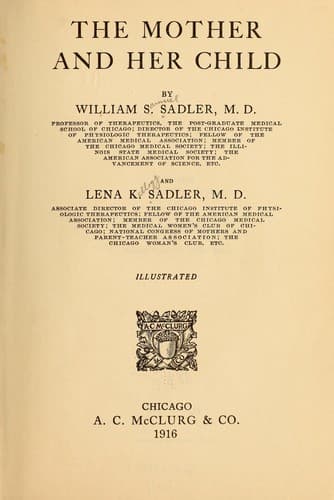
The Mother and Her ChildSadler, William S. (William Samuel)
Science
The Mother and Her Child
Sadler, William S. (William Samuel)
Child care; Infants -- Care; Infants -- Health and hygiene; Pregnancy
The paroxysmal cry, very severe for a time and then ceasing
absolutely, is probably due to colic, particularly if accompanied
by the distention of the abdomen and the movements of the body
already referred to. A frequent, peevish, whining cry is heard in
children with general poor health or discomfort. A single shrill
scream uttered now and then is often heard in inflammation of the
brain. In any disease in which there is difficulty in getting
enough air into the lungs, as in pneumonia, the cry is usually
very short and the child cries but little, because it cannot hold
its breath long enough for it. A nasal cry occurs with cold in
the head.
A short cry immediately after coughing indicates that the cough
hurts the chest. Crying when the bowels are moved shows that
there is pain at that time. A child of from two to six years,
waking at night with violent screaming, is probably suffering
from night terrors. In conditions of very great weakness and
exhaustion the baby moans feebly, or it may twist its face into
the position for crying, but emit no sound at all. This latter is
also true in some cases of inflammation of the larynx, while in
other cases the cry is hoarse or croupy. Crying when anything
goes into the mouth makes one suspect some trouble there. If it
occurs with swallowing, it is probable that the throat is
inflamed.
With the act of crying there ought always to be tears in children
over three or four months of age. If there are none, serious
disease is indicated, and their reappearance is then a good sign.
COUGHING
The character of the cough is also instructive. A frequent, loud,
nearly painless cough, at first tight and later loose, is heard
in bronchitis. A short, tight, suppressed cough, which is
followed by a grimace, and, perhaps, by a cry, indicates some
inflammation about the chest, often pneumonia. There is a brazen,
barking, "croupy" cough in spasmodic croup. In inflammation of
the larynx, including true croup, the cough may be hoarse,
croupy, or sometimes almost noiseless.
The cough of whooping cough is so peculiar that it must be
described separately when considering this disease. Then there
are certain coughs which are purely nervous or dependent upon
remote affections. Thus the so-called "stomach cough" is caused
by some irritation of the stomach or bowels. It is not nearly so
frequent as mothers suppose. Irritation about the nose or the
canal of the ears sometimes induces a cough in a similar way.
Enlarged tonsils or elongated palate or throat irritation may
also produce a cough.
THE BREATHING
Public-domain text, read in full here on John Shaqi.
Reviews
Reviews
No reviews yet
Be the first to share your thoughts on this work.
Elsewhere in the archive
Join the Discussion
Join the discussion
Sign in to leave a comment or review.
Sign InorCreate an account