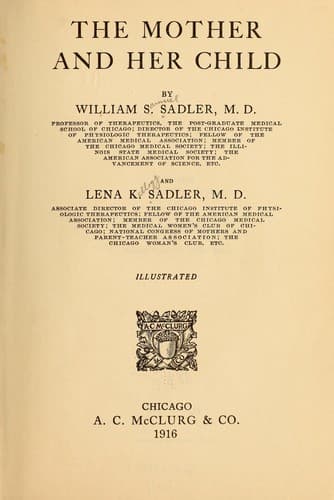
The Mother and Her ChildSadler, William S. (William Samuel)
Science
The Mother and Her Child
Sadler, William S. (William Samuel)
Child care; Infants -- Care; Infants -- Health and hygiene; Pregnancy
The breathing of a young child, particularly if under one year of
age and awake, is always slightly irregular. If it becomes very
decidedly so, we suspect disease, particularly of the brain. A
combination of long pauses, lasting half a minute or a minute,
with breathing which is at first very faint, gradually becomes
more and more deep, and then slowly dies away entirely, goes by
the name of "Cheyne-Stokes respiration," and is found in
affections of the brain. It is one of the worst of symptoms
except in infancy, and even then it is very serious.
The rate of respiration is increased in fever in proportion to
the height of the temperature. It is increased also by pain in
rickets, and especially in some affections of the lungs. Sixty
respirations a minute are not at all excessive for a child of two
years with pneumonia, and the speed is frequently decidedly
greater than this.
Breathing is often very slow in disease of the brain,
particularly tubercular meningitis. Poisoning by opiates produces
the same effect. Frequent deep sighing or yawning occurs in
affections of the brain, in faintness, or in great exhaustion,
and may be a very unfavorable symptom. Breathing entirely through
the mouth shows that the nose is completely blocked, while
snuffling breathing is the result of a partial catarrhal
obstruction. A gurgling in the throat not accompanied by cough
may indicate that there is mucus in the back part of it, the
result of an inflammation, sometimes slight, sometimes serious.
"Labored" breathing, in which the chest is pulled up with each
breath while the muscles of the neck become tense, the pit of the
stomach and the spaces between the ribs sink in, and the edges of
the nostrils move in and out, is seen in conditions where the
natural ease of respiration is greatly interfered with, as in
pneumonia, diphtheria of the larynx, asthma, and the like.
Long-drawn, noisy inspirations and expirations are heard in
obstruction of the larynx, as from laryngeal diphtheria or
spasmodic croup.
THE PULSE
The rate of the pulse is subject to such variations in infants
that its examination is of less value than it would otherwise be.
In early childhood its observation is of more service, although
even then deceptive. Slight irregularity is not uncommon. Unusual
irregularity is an important symptom in affections of the brain
or heart. Fever produces an increase in the pulse rate, the
degree of which depends, as a rule, upon the height of the
temperature. Slowing of the pulse is a very significant symptom,
seen particularly in affections of the brain, and sometimes in
Bright's disease and jaundice.
THE TEMPERATURE
Public-domain text, read in full here on John Shaqi.
Reviews
Reviews
No reviews yet
Be the first to share your thoughts on this work.
Elsewhere in the archive
Join the Discussion
Join the discussion
Sign in to leave a comment or review.
Sign InorCreate an account