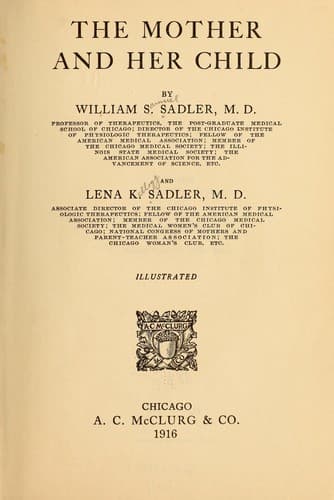
The Mother and Her ChildSadler, William S. (William Samuel)
Science
The Mother and Her Child
Sadler, William S. (William Samuel)
Child care; Infants -- Care; Infants -- Health and hygiene; Pregnancy
Habit spasms or "tics" are common in childhood, and are caused by an
over irritability of the nerves supplying certain groups of muscles.
It is not at all uncommon to see a child nervously blink the eyes,
twitch the nasal muscles, shrug the shoulders, constantly open and
close the hand, and execute a score of other minor habit-spasms;
which, day by day, wear deeper and deeper paths into his nervous
system as a result of their constant repetition. These minor
habit-spasms of childhood are but telltales of an unstable nervous
system, of a nervous heredity lacking poise and balance; and, mind
you, if this nervous system is studied, treated, and properly
harnessed with self-understanding and self-control, much may be
accomplished; the habit may be more or less completely eradicated. If
left to itself, unchecked, the habit deepens the "spasm-groove," and
the "energy-leaks" grow bigger and bigger until finally, in later,
adult life, all that is necessary to convert such persons into
first-class neurasthenics or hysterics is some bad news, a few
worries, or a sudden shock.
By all means study to nip all childhood twitchings in the bud;
remembering all the while that childhood--the formative period for the
nervous system of the child--presents the golden opportunity to
prevent and abort the more grave neuroses of later life. There may be
a special contraction of one or more muscles of the eyeball which
produces either a "cross-eye," when the contraction is convergent, or
a turning of one eye outward when the contraction is divergent. It is
not possible for the mother to correct this condition. The one
important thing for her to do is to take the child to a skilled
ophthalmologist early in his life, that treatment may be instituted
for the correction of the difficulty.
RETENTION OF URINE
Not an unusual condition during childhood is a temporary retention of
urine. It may follow an attack of colic or accompany any acute
illness. Increase the water drinking, and, after seven or eight hours,
hot cloths should be applied over the bladder; a large enema (enema
bag should be hung low) should also be given, retaining as much as is
possible. These simple measures usually relieve the condition. If
retention follows circumcision, due to swelling of the parts, the
surgeon should be notified.
BED WETTING
Nocturnal enuresis (bed wetting) usually is found to "run in
families." It is seldom the case to find that both the father and the
mother escaped bed wetting during childhood when the child is sorely
afflicted.
Public-domain text, read in full here on John Shaqi.
Reviews
Reviews
No reviews yet
Be the first to share your thoughts on this work.
Elsewhere in the archive
Join the Discussion
Join the discussion
Sign in to leave a comment or review.
Sign InorCreate an account