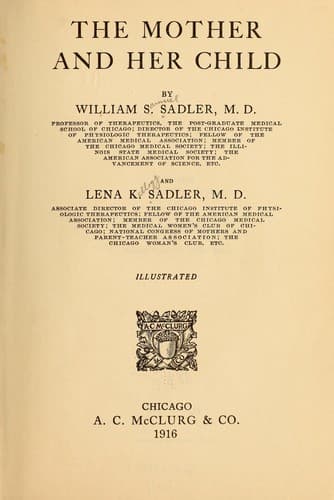
The Mother and Her ChildSadler, William S. (William Samuel)
Science
The Mother and Her Child
Sadler, William S. (William Samuel)
Child care; Infants -- Care; Infants -- Health and hygiene; Pregnancy
Early bad habits may be the prime factor in this distressing and
humiliating difficulty. A little child that has been compelled to lie
in wet diapers for hours at a time gradually becomes accustomed to
"being wet," and the desire to urinate is not under the keen control
of a will that has been trained by untiring patience to "sit on a
chair" at regular intervals throughout the day. This lack of training
in a child who possesses an unstable nervous system, creates the
proper environment for the habit of bed wetting--which often marches
steadily on until puberty. In the treatment of bed wetting give
attention to the following:
1. The urine should be thoroughly examined.
2. The size of the bladder should be determined.
3. The last meal of the day should not be after four o'clock in the
afternoon.
4. All during the day, in young children, systematic training should
be begun--put the child on the chair every hour, then every hour and a
half, then every two hours. Let the work be done most painstakingly
and much will be accomplished toward training the bladder to "hold its
contents" during the night. For a time it will be necessary to set an
alarm clock to ring every three hours during the night, that the
bladder may be relieved at regular intervals.
5. No liquids whatever are allowed after four P. M.; even the four
o'clock meal should be very light.
6. In older children the habit is often broken by appealing to the
pride--by requesting or demanding the child to rinse out the bed linen
and hang it up to dry himself.
Usually at puberty the trouble ends, and while no amount of whipping
will correct the difficulty, the promise of rewards, an appeal to the
pride, correction of dietetic errors, the establishment of regular
times to empty the bladder, the removal of all reflex causes such as
adenoids, need of circumcision, worms, etc.--these combined
influences--will bring results in the end, if they are faithfully and
intelligently applied.
MENINGITIS
Cerebro-spinal meningitis is not highly contagious. Children old
enough to complain of symptoms usually first complain of an intense
headache with frequent vomiting and very high fever. Great prostration
is seen, the pulse is weak, the respirations are irregular, the child
may have convulsions, or it may have chills and fever, and rigidity of
the body may be present. The position of the child is very
characteristic. It does not want to lie on its back but usually rests
on one side, with the spine more or less arched. It is a very serious
disease and demands the early attention of a physician. Some cases
are very mild and others are exceedingly grave. If the physician is
secured early, and special remedies administered that are known today,
many of the children may be saved.
INFANTILE PARALYSIS
Public-domain text, read in full here on John Shaqi.
Reviews
Reviews
No reviews yet
Be the first to share your thoughts on this work.
Elsewhere in the archive
Join the Discussion
Join the discussion
Sign in to leave a comment or review.
Sign InorCreate an account