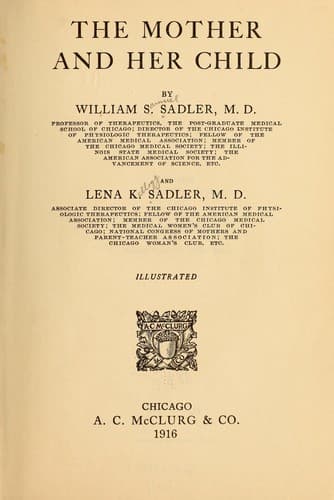
The Mother and Her ChildSadler, William S. (William Samuel)
Science
The Mother and Her Child
Sadler, William S. (William Samuel)
Child care; Infants -- Care; Infants -- Health and hygiene; Pregnancy
It is wise to seek medical advice in the case of odd or unusual
behavior after a fall on the head.
CHAPTER XXXV
DIET AND NUTRITION
Most interesting is the study of the food as it passes through the
processes of digestion, absorption, assimilation, and oxidation--all
definite and important parts of the great cycle through which
everything we eat passes on its way from the table to the tissues.
Elimination is the last step in nutrition, and is the process by which
the body rids itself of the broken down cells and other poisonous and
useless wastes. These various phases of bodily nutrition may be
expressed in a single term--metabolism.
What we eat and how much we eat must be carefully planned, for our
body temple is really made of what we eat. If you were erecting a
beautiful mansion you would not think of allowing cheap, trashy, and
inferior building materials to enter into the construction of your
home. Neither should you permit unfit and inferior materials to become
a part of the daily dietary of your little boy or girl, thus to become
a part of their bodily structure.
ASSIMILATION OF FOOD
Following the process of digestion in the stomach and intestine, the
nutritive food elements are absorbed through the wall of the bowel by
the wonderfully adapted little villus, and distributed by various
routes to the uttermost parts of the body. The sugars (all starches
are changed into sugar) are carried in the portal blood stream to the
liver, where they are actually stored away in the form of glycogen
which, in a most intelligent manner, is dealt out to the body from
hour to hour as it is needed for fuel. If all the sugar, after a
hearty meal, were poured into the circulation at once, the blood
stream would be overwhelmed and the kidneys would be forced to
excrete it in the urine. This unnecessary waste is avoided by the
liver's storing sugar after each meal and dealing it out to the body
as required.
Likewise, the proteins also pass through the liver on their way to the
body. Just what action the liver exerts upon proteins is not wholly
known at the present writing. The digested fats are absorbed at once
by the lacteals, the beginning of the intestinal lymphatic system, by
which they are carried to the large veins at the root of the neck and
there emptied into the blood stream. We have now traced our various
food elements through the processes of digestion and absorption in the
alimentary tract, some going through the liver, and others through the
lymphatic system, until they circulate in the blood stream itself.
It is from these food substances, circulating in the blood stream,
that the various cells of the body must assimilate into themselves
such portions as they require for purposes of heat and energy and for
the repair of their cell substance. This specialized work of cell
assimilation converts the dissolved watery food in the blood into
solid tissues, exactly reversing the process of digestion.
Public-domain text, read in full here on John Shaqi.
Reviews
Reviews
No reviews yet
Be the first to share your thoughts on this work.
Elsewhere in the archive
Join the Discussion
Join the discussion
Sign in to leave a comment or review.
Sign InorCreate an account