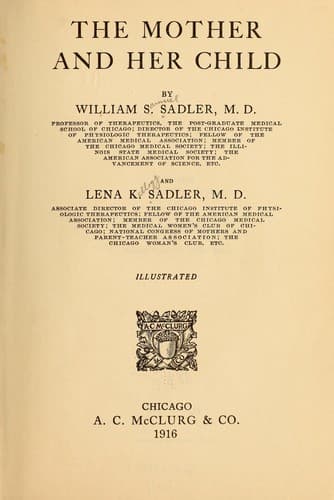
The Mother and Her ChildSadler, William S. (William Samuel)
Science
The Mother and Her Child
Sadler, William S. (William Samuel)
Child care; Infants -- Care; Infants -- Health and hygiene; Pregnancy
With a most profound intelligence, each of these body cells and
tissues, bone and nerve fiber, muscle and organ, selects from the
blood stream just its supply or portion of the food elements requisite
to its upbuilding and maintenance. The mysteries of assimilation are
effected by means of chemical substances called "enzymes," similar to
those found in the digestive organs, but acting in an entirely
different manner, in that they build up solids out of liquids instead
of converting solids into liquids.
ELIMINATION OF BODY WASTES
Metabolism consists of a twofold role--an upbuilding and a tearing
down process. After the food is all digested, absorbed, and
assimilated, having become a part of the bodily organ, bone, muscle,
and nerve fiber, then begins the work of tearing it down--of
liberating its heat and energy--to be followed by its elimination
from the body through the sweat glands, uriniferous tubules of the
kidneys, etc. The carbohydrates (starches and sugars), together with
the fats, are completely burned up in the body and are then eliminated
in the form of water (thrown off through the sweat) and carbonic acid
gas given up by the lungs.
The proteins, or nitrogenous foods, are not so completely burned up in
the body. The ashes which result from their combustion are not simple
substances like the water and CO_{2} of the carbohydrates. This
protein ash is represented by a number of complicated substances, some
of which are solid (protein clinkers), which accumulate in the body
and help to bring about many diseases, such as gout, headache,
fatigue, biliousness, etc.
These protein ashes and clinkers are further acted upon--split up and
sifted--by the liver, and are finally eliminated by the kidneys in the
form of urea, uric acid, etc. The body being unable to store up
protein, is often greatly embarrassed when one eats more of this
substance than is daily required to replenish the waste of the body,
for it must all be immediately split up in the system, and the
over-abundant and irritating ashes must be carried off by the
eliminating organs. Now, the overeating of sugars, starches, or fats,
is not such a serious matter, as they may be stored in the liver and
subsequently used; and even if they are eaten in excess of what the
liver can care for they accumulate as fat or add extra fuel to the
fires of the body, their ashes being carried off in the form of such
harmless substances as water and carbon dioxide (CO_{2}); but the
overeating of protein substances is always a strain on the body and
should be avoided.
ELEMENTS OF NUTRITION
There are seven distinct elements entering into the composition of
human foods--protein, starch, sugar, fat, salts, cellulose, and water,
not to mention enzymes, vitamines, and other little-known chemical
principles. These elements are all variously concerned in the
nourishment, energizing, and warming of the body.
PROTEINS
Public-domain text, read in full here on John Shaqi.
Reviews
Reviews
No reviews yet
Be the first to share your thoughts on this work.
Elsewhere in the archive
Join the Discussion
Join the discussion
Sign in to leave a comment or review.
Sign InorCreate an account