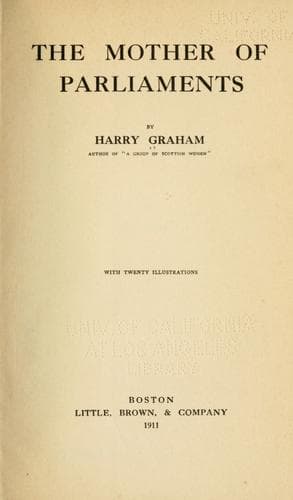
Great Britain. Parliament; Great Britain. Parliament -- History; Representative government and representation
For a short time he remained quiet, and then suddenly, in 1882, he
reappeared in the House of Commons, walked alone to the Table,
administered the oath to himself, and claimed the right to sit. Upon a
motion of Sir Stafford Northcote he was once more expelled, and once
more the electors of Northampton returned him as their representative.
During the two following years Bradlaugh brought actions against the
Sergeant-at-Arms and his deputy, and tried to induce a court of law to
restrain these officials from carrying out the orders of the House.
His efforts, however, were vain, the courts deciding that the Commons
had a perfect right to control their own internal affairs.
In 1884 he again entered the House and took the oath. He was again
excluded from the precincts, applied for the Chiltern Hundreds, and
was again returned for Northampton.
Meanwhile he had voted in several divisions, and the Attorney-General,
on behalf of the Crown, brought an action against him to recover three
separate sums of £500, as penalties for having voted without
previously taking the oath.
For two more years the conflict continued to rage round the burly
figure of this remarkable man. By 1886, however, the Commons had grown
weary of this ceaseless and senseless persecution, and Bradlaugh was
at last permitted to take his seat; and in 1888 an Act was passed
extending the right to affirm to those who state that they have no
religious belief.
Parliament thus gradually came to take a broader view of the
situation, and during Bradlaugh's absence, in 1891, the House of
Commons passed a resolution expunging from the Journals the original
motion whereby he was prevented from affirming. Thus ended a long
controversy, in the course of which the much-harassed victim had
behaved with exemplary self-control, only once showing signs of
annoyance, when the rough handling to which he was subjected by the
police resulted in the breakage of a favourite stylographic pen.
This taking of the oath or making an affirmation at the commencement
of a new Parliament is the only introduction necessary for a member
who has been elected during the recess, or of a peer who has succeeded
to a title.
The introduction of a newly created peer, or of one who has been
elevated to higher rank, is a ceremony that strikes the spectator as
quaint or impressive, according as he has or has not a sense of
humour. Attired in his robes, and supported by two other peers of his
own degree, who act as his sponsors, the new peer walks slowly up the
floor of the House of Lords, preceded by a procession of State
officers--Black Rod, Garter King-at-Arms, the Hereditary Earl Marshal
of England, and the Lord Great Chamberlain, in full dress.
Public-domain text, read in full here on John Shaqi.
Reviews
Reviews
No reviews yet
Be the first to share your thoughts on this work.
Elsewhere in the archive
Join the Discussion
Join the discussion
Sign in to leave a comment or review.
Sign InorCreate an account