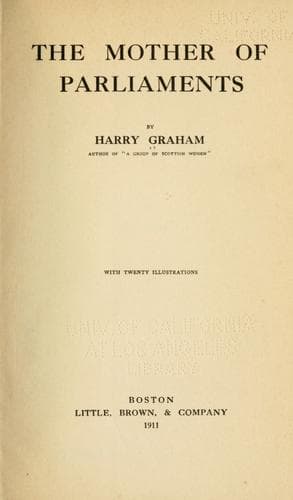
Great Britain. Parliament; Great Britain. Parliament -- History; Representative government and representation
The principle of Party Government, which now lies at the very root of
our parliamentary system, had its origin during the second period of
parliamentary history, and formed no part of the constitutional scheme
of earlier days.
In Queen Elizabeth's time two definite and distinct parties arose, the
one maintaining the privileges of the Crown, the other upholding the
interests of the people. In Stuart days Cavaliers and Roundheads were
followed by Court and Country Parties, and in the year 1679, when the
Exclusion Bill was being bitterly debated, the distinctive names of
"Whigs" and "Tories" first came into existence. "Whig" was originally
a word applied to the lowland peasantry of the West of Scotland;
thence it came to mean Covenanters, and so politicians who looked
kindly upon Nonconformity. "Tory" was an expression popularly used
with reference to the rebel Irish outlaws who harassed the
Protestants; and thus implied leanings towards Catholicism.[29]
[29] O'Connell showed Pryme an Irish Act of Parliament for the
suppression of "Rapparees, Tories, and other Robbers." Pryme's
"Recollections," p. 231.
The growth of a respect for the people's rights forced politicians to
separate into two sections, and the schism between the rival camps was
still further emphasized by the Revolution of 1688. Regular opposing
parties do not, however, seem to have existed in the Commons until the
eighteenth century, and the party system was not finally established
as a necessary element of constitutional government until the reign of
William III. Kings had hitherto chosen their advisers irrespective of
their political views. William III. was, however, induced by the Earl
of Sunderland to form a Ministry from the party that held a majority
in Parliament, and thus became to a certain extent controlled by that
party.
Public-domain text, read in full here on John Shaqi.
Reviews
Reviews
No reviews yet
Be the first to share your thoughts on this work.
Join the Discussion
Join the discussion
Sign in to leave a comment or review.
Sign InorCreate an account